
How Early Should You Arrive at the Airport in 2026?
Stop guessing with generic advice. This guide breaks down the five key factors — checked bags, airport size, time of day, trusted traveler status, and destination — to give you a personalized arrival time for your 2026 flight.
90 minutes
arrival-time · Domestic/International
If you are asking how early to arrive at the airport in 2026, start with this: the fastest reasonable airport arrival time is about 60 minutes before departure, but only for a narrow traveler profile — domestic flight, carry-on only, mobile boarding pass, TSA PreCheck, no special assistance needs, and a willingness to accept some risk. Nate Silver’s tracked set of 800 flights is useful because it shows that this kind of lean arrival can work, not because it should become everyone’s new rule.[1]
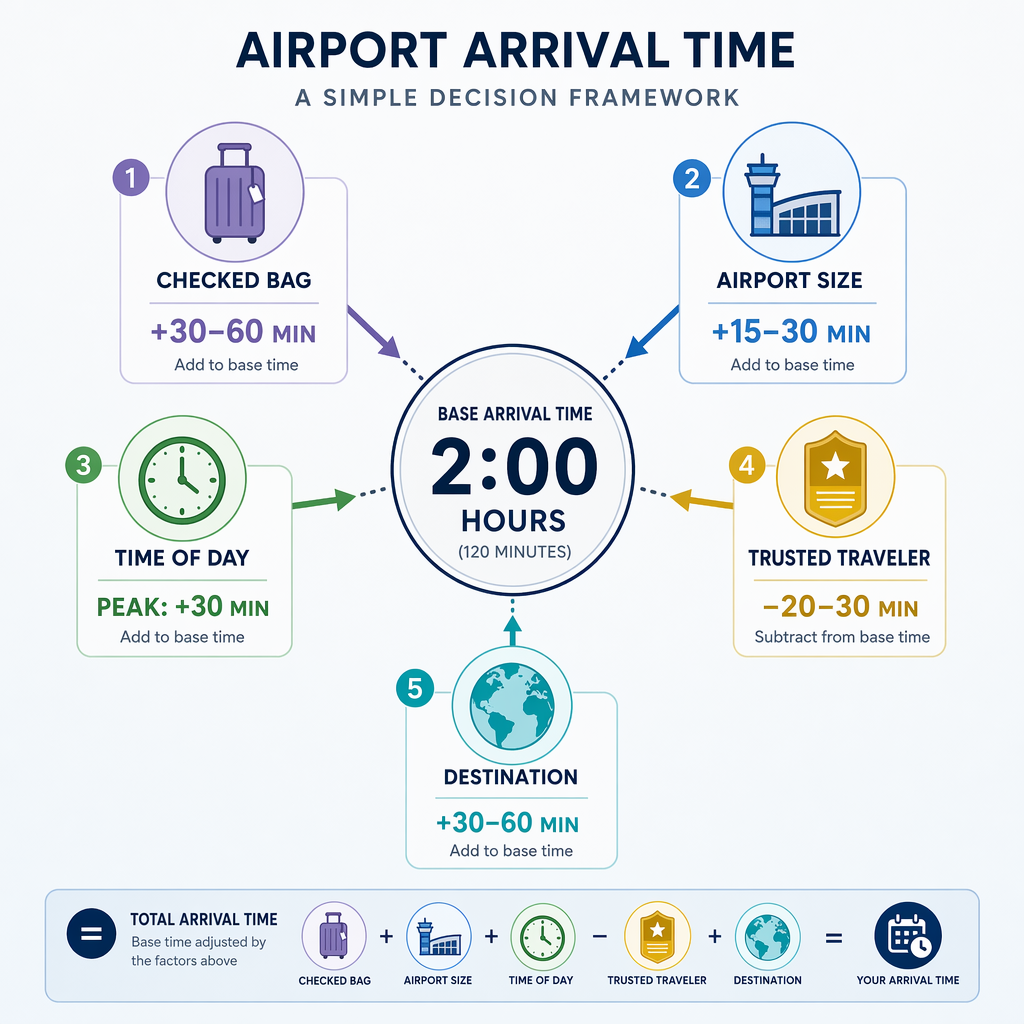
For most travelers, the better planning number is not 60 minutes. It is a base window adjusted by five things you already know before you leave home: whether you are checking a bag, how large or congested the airport is, whether your flight is during a peak travel window, whether you have a trusted traveler lane, and whether the flight is domestic or international.
| Your trip setup | Practical airport arrival target |
|---|---|
| Domestic, carry-on only | About 90 minutes before departure |
| Domestic, checked bag | About 2 hours before departure |
| International, carry-on only | About 2 to 2.5 hours before departure |
| International, checked bag | About 2.5 to 3 hours before departure |
| Peak morning, late afternoon, holiday, or major hub | Add 30 to 60 minutes |
| Regional airport, carry-on only, PreCheck, normal day | You may be closer to 60 to 90 minutes |
That table is the answer most people need before the ride is ordered. The rest of the decision is about not applying the wrong row to yourself. A solo traveler with a backpack and PreCheck at a regional airport is not playing the same game as a family checking bags for an international flight from LAX on the Friday before a holiday.
The 60-Minute Arrival Is a Floor, Not a Default
Silver’s 60-minute base case deserves attention because it is built from observed behavior across 800 tracked flights, not from a recycled airport slogan.[1] It also has tight assumptions. He is not describing the passenger who has to find the airline counter, print a bag tag, wait for an agent, walk a stroller through security, or ask where wheelchair assistance begins.
The number works best as a floor: the lowest serious planning point for an efficient domestic traveler who can go straight to security. Once one of those assumptions changes, the clock changes. The fastest airport traveler is doing fewer airport tasks, not magically moving through the same tasks faster.
This is where the old two-hour domestic rule becomes both helpful and annoying. It usually protects you from a bad morning. It also quietly charges a lot of people an extra half hour, hour, or more when the trip is simple. A factor-based target lets the low-friction traveler stop overcorrecting while giving the high-friction traveler the time they actually need.
Start With the Bag, Because the Bag Changes the Airport
The first question is not domestic or international. It is whether you are checking a bag. A checked bag can add 30 to 60 minutes because it sends you to a different part of the airport process: airline counter or kiosk, bag-drop line, agent cutoff rules, and then security.[2][3]
Carry-on only with a mobile boarding pass is the cleanest path. You enter the terminal, confirm the gate if needed, and go to screening. That is the setup where a 60- to 90-minute arrival can make sense, especially at a smaller airport on a normal travel day.[1][2]
Checked bags turn “arrival time” into “bag deadline management.” Airlines can stop accepting checked bags before departure, and missing that cutoff may mean you technically reached the airport but still cannot fly with your luggage. That is why the domestic checked-bag target should usually begin around two hours, not because every minute will be busy, but because the bag line is an upstream risk you cannot fix at the gate.[2][3]
| If this is true | Adjust your arrival time |
|---|---|
| Carry-on only, mobile boarding pass, domestic | Use 90 minutes as the normal target; consider 60–75 only if the airport and timing are low-risk |
| One checked bag, domestic | Use 2 hours as the normal target |
| Multiple checked bags, family group, sports gear, or counter service likely | Add another 15–30 minutes |
| International checked bag | Use 2.5–3 hours before departure |
This is the most common place travelers borrow advice from the wrong person. “I got there 55 minutes early and was fine” may be true for someone who never touched the airline counter. It is not evidence that a checked-bag passenger should do the same.
Airport Size Matters Less Than the Work It Adds
Large airports do not require more time just because they are famous. They require more time because the distances, checkpoint choices, curb congestion, terminal transfers, and gate walks can all add small delays that stack. TripBuffer and On Air Parking both treat major hubs such as JFK, ATL, ORD, DFW, LAX, and IAH as airports where an extra 15 to 30 minutes can be reasonable for congestion and walking time.[2][4]
That buffer is not glamorous, but it is often the difference between a calm walk and a very specific kind of airport math: 11 minutes to the checkpoint, 18 minutes in screening, 14 minutes to the gate, boarding already underway. A traveler with a boarding pass in hand can still lose the morning to terminal geometry.
Regional airports cut the other way. When the curb, checkpoint, and gates are close together, 90 minutes can be plenty for many domestic carry-on trips, and some efficient PreCheck travelers may choose less when live conditions look normal.[1][2] For international departures, even a smaller airport usually deserves more space because document checks and airline procedures add steps.
- Add 15–30 minutes if you are flying from a major hub, unfamiliar terminal, or airport with long gate walks.
- Stay near the base target if it is a compact regional airport and you are not checking a bag.
- Add time if you need parking shuttles, rental-car return, terminal transfers, or an airline counter before security.
The Worst Airport Time Is Often Before the Workday Starts
A 6:15 a.m. departure can look easy until everyone else has the same idea. Travel + Leisure and AAA identify early morning, especially roughly 5 a.m. to 8 a.m., and late afternoon into early evening, roughly 4 p.m. to 7 p.m., as peak windows where travelers should build in more time.[3][5]
For those windows, add about 30 minutes before you start making optimistic assumptions. If the flight is also on a holiday week, school-break period, or weather-prone travel day, the add-on can move toward 60 minutes.[2][5][8]
The March 2026 DHS shutdown is worth mentioning only as a caution about stale advice. During that disruption, some airport wait times spiked sharply, with reports of four-plus-hour waits at airports including ATL and IAH, but that was a temporary event that was resolved by April.[6] By Q3 2026, the practical planning question is not emergency shutdown behavior; it is ordinary variation plus summer and holiday volume.
Summer volume is still real. Tampa International Airport said it expected 6.1 million passengers for its 2026 summer travel season and continued to recommend the familiar two-hour domestic and three-hour international arrival windows.[7] That kind of official advice is intentionally blunt. It has to cover families, checked bags, first-time flyers, and travelers who will not check conditions before leaving.
PreCheck and CLEAR Can Shrink the Buffer, But They Do Not Erase It
Trusted traveler lanes change the security portion of the trip, not the whole trip. TripBuffer and CNN both point to TSA PreCheck and CLEAR as time-savers that can reduce the security buffer, often by roughly 20 to 30 minutes when the lanes are operating well.[2][6]
The trap is subtracting those minutes from tasks they do not affect. PreCheck does not return a rental car. CLEAR does not check your suitcase. Neither one moves your departure gate closer. At some airports and at some peaks, a PreCheck line can also be longer than expected, so the membership should be treated as a useful discount, not a guarantee.[6]
| Trusted traveler status | How to use it in your arrival math |
|---|---|
| No PreCheck or CLEAR | Do not subtract time; use the full base window |
| PreCheck only | Consider subtracting 15–20 minutes from a low-risk carry-on trip, but not from checked-bag or international processing |
| PreCheck plus CLEAR | Consider subtracting 20–30 minutes when the airport usually runs those lanes efficiently |
| Peak holiday or known congestion | Keep the buffer unless same-day wait data confirms conditions are light |
Domestic or International Is the Last Big Switch
Domestic flights are simpler because there is usually less document review before departure. For a domestic carry-on trip, TripBuffer’s 2026 guidance starts around 1.5 hours. With a checked bag, it moves to about 2 hours.[2]
International flights add document checks, possible visa or passport review, longer airline counter interactions, and less room for improvising if something is wrong. TripBuffer places international carry-on travelers around 2 to 2.5 hours and international checked-bag travelers around 2.5 to 3 hours.[2] Skyscanner’s broader airport guidance also keeps international departures in the longer-arrival category rather than treating them like domestic flights with a different gate.[8]
This is also where special circumstances belong in the calculation. If you need wheelchair assistance, are traveling with children, have an unaccompanied minor, have a pet, are dealing with REAL ID or document uncertainty, or know someone in the group moves slowly through airports, add time before the day-of stress arrives.[3][5]
Build Your Arrival Time in 60 Seconds
Use this as a planning sequence, not a personality test. Start with the row that matches your trip, then adjust once. Do not keep adding the same risk under five different names.
- Choose your base: 90 minutes domestic carry-on, 2 hours domestic checked, 2–2.5 hours international carry-on, or 2.5–3 hours international checked.
- Add 30–60 minutes if you are checking bags in a complicated situation, traveling during holidays, or flying at a known peak period.
- Add 15–30 minutes for a major hub, unfamiliar airport, long terminal transfer, remote parking, or rental-car return.
- Subtract 20–30 minutes only if you have PreCheck or CLEAR, are not checking a bag, and same-day conditions look normal.
- Add time for children, elderly travelers, mobility assistance, unaccompanied minors, pets, or document uncertainty.
A simple example: domestic flight, no checked bag, medium-size airport, PreCheck, midday Tuesday. Start at 90 minutes. If the airport is easy and the MyTSA or airport wait data looks normal, arriving 75 to 90 minutes before departure may be reasonable. Another example: international flight, checked bag, major hub, 7 a.m. departure, family group. Start at 2.5 to 3 hours, then add time for the peak window and group logistics. That trip is not being “overly cautious” at three hours; it has more airport work built into it.
The Final Check Before You Leave
Static arrival rules are for planning. Same-day conditions get the final vote. Before you leave, check your airline app for bag-drop or boarding alerts, the airport website for checkpoint or parking updates, and the MyTSA app for security wait information. If those sources disagree with your plan, believe the live conditions.
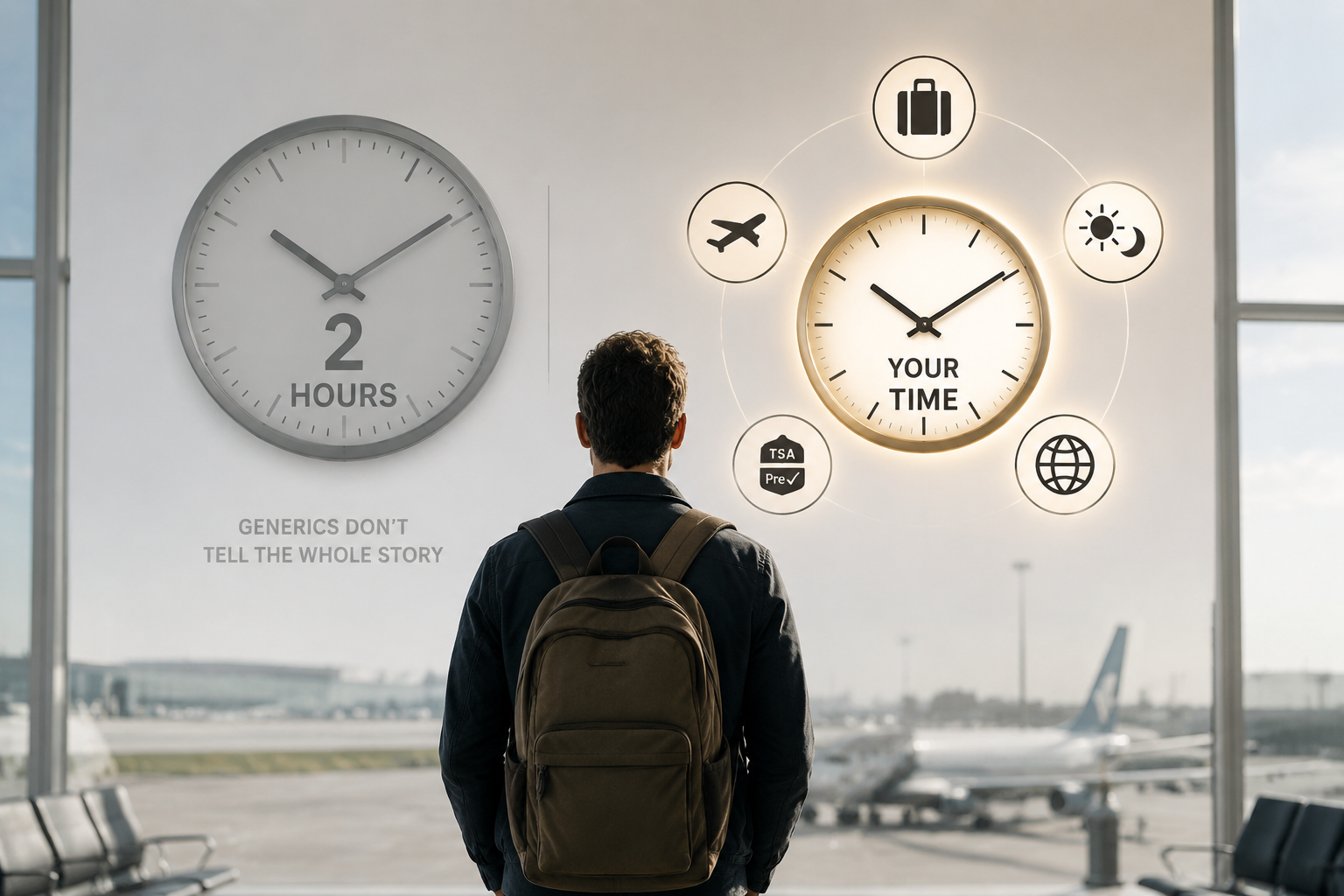
The old two-hour domestic and three-hour international rule is safe, but it is blunt. A factor-based framework can save many travelers 30 to 90 minutes of unnecessary waiting without encouraging reckless arrivals. It also prevents the bigger mistake: treating a solo PreCheck carry-on flight at a regional airport like a checked-bag international departure from a major hub on a holiday morning.
References
- I've tracked my last 800 flights — natesilver.net
- How Early to Get to the Airport in 2026 — TripBuffer, July 2026
- How Early to Arrive at the Airport: Expert Tips — Travel + Leisure
- TSA Wait Times 2026 — On Air Parking
- How Early Should You Arrive at the Airport? — Club Alliance/AAA
- What to know about TSA PreCheck and Clear during the DHS shutdown — CNN
- TPA gears up for a busy 2026 summer travel season — Tampa International Airport
- How early should you get to the airport — Skyscanner
Does this not match what you experienced?
Especially for connection-time estimates, we want to hear about it. Report a correction.