
Should You Get Global Entry or TSA PreCheck?
Global Entry costs only $42 more than TSA PreCheck over five years but includes expedited customs clearance. This guide compares costs, benefits, and application hassles to help you decide which trusted traveler program fits your 2026 travel patterns.
TSA and CBP · Applies to: Both
Rule last reviewed:
If you expect even one international trip a year, Global Entry is usually the better five-year value. It costs $120 for five years, or $24 a year, and includes TSA PreCheck plus expedited customs processing when you return to the U.S. TSA PreCheck is still the cleaner choice if your flying is domestic, your trip is soon, or you do not want to chase a Customs and Border Protection interview slot. Standalone PreCheck costs $78 for five years, or $15.60 a year, through TSA’s published baseline pricing, though actual provider pricing can vary slightly.[1][2]
That makes the real global entry vs tsa precheck question less about which program sounds better and more about whether the extra $42 and the interview hassle buy you something you will actually use.
| Question | TSA PreCheck | Global Entry |
|---|---|---|
| Five-year cost | $78 baseline new enrollment, or $15.60 per year; provider pricing can vary | $120, or $24 per year |
| What it speeds up | Airport security screening before departure | Airport security through TSA PreCheck benefits, plus expedited customs processing after international travel |
| Airport reach | Available at 200+ U.S. airports | Available at 75+ airports worldwide for expedited customs |
| Application burden | Online application plus in-person enrollment visit; many travelers receive a Known Traveler Number within 3–5 business days after the visit | Online application, conditional approval, then a CBP interview; appointment availability can be the sticking point |
| Best fit | Domestic-only travelers and anyone who needs a KTN quickly before a near-term trip | Travelers with international trips on the calendar, especially if they can schedule the interview or use Enrollment on Arrival |
| Family note | Children may be able to use PreCheck with an eligible parent depending on TSA rules and age | Since October 1, 2024, minors under 18 can enroll in Global Entry for free when a parent or legal guardian is already a member or is applying at the same time |
| Upgrade path later | No simple upgrade to Global Entry; you must submit a new Global Entry application and pay the full fee | Already includes TSA PreCheck benefits for eligible members |
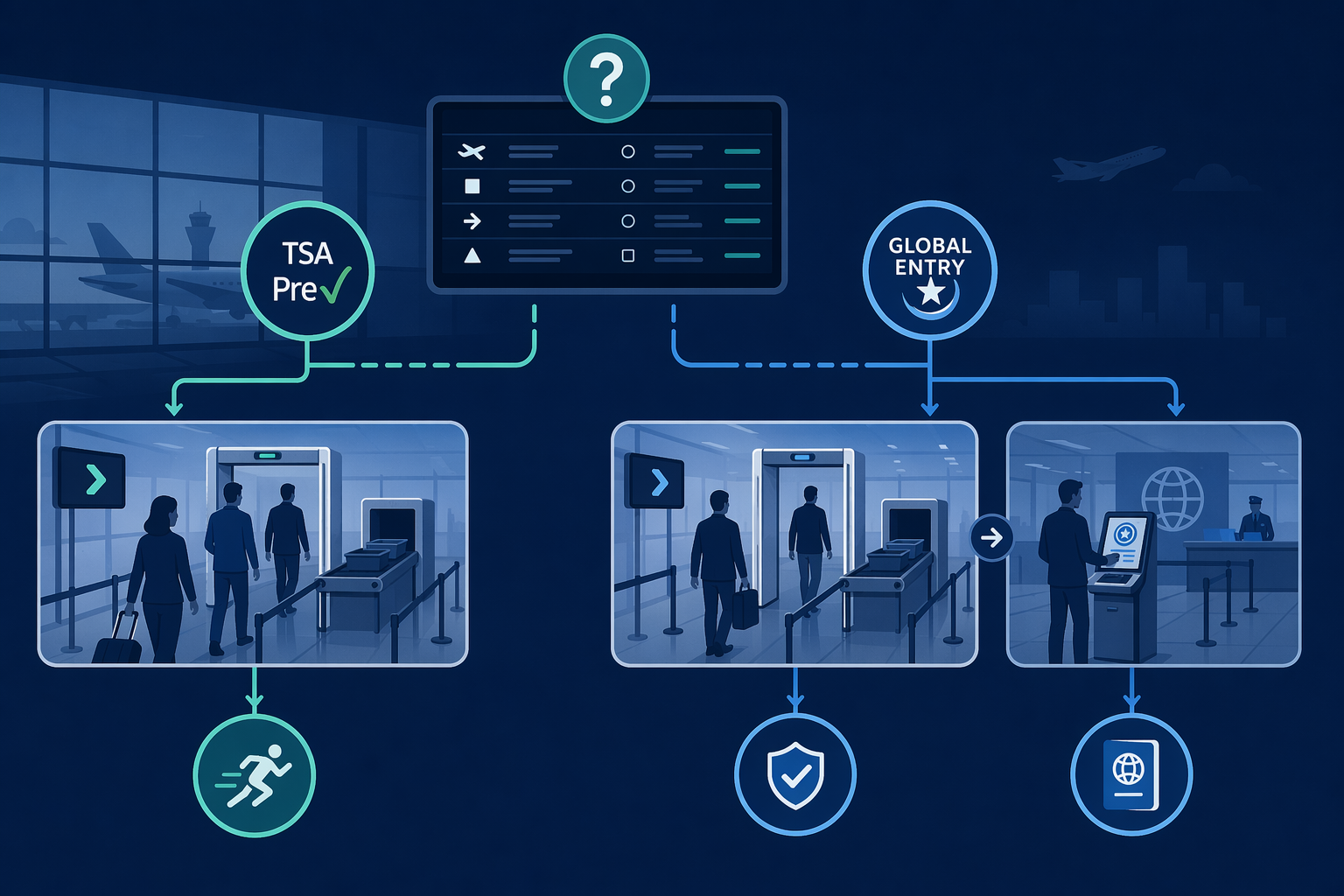
The $42 Difference Is Smaller Than the Interview Difference
On price alone, Global Entry is hard to argue against for anyone who leaves the country even occasionally. Over five years, the difference between the two programs is $42. Annualized, that is $24 a year for Global Entry versus $15.60 a year for TSA PreCheck, before accounting for PreCheck provider price variation.[1][2]
For that extra cost, Global Entry does not replace PreCheck; it includes it for eligible members. That is the quiet arithmetic that matters. A traveler who buys PreCheck first gets the faster domestic security lane, but if they later decide they want Global Entry, there is no cheap conversion. They have to file a new Global Entry application, pay the $120 fee, and go through CBP vetting and interview requirements.[3]
That no-upgrade detail is easy to miss when you are trying to solve one immediate trip. It also makes a reasonable short-term choice more expensive later. If you pay for TSA PreCheck because you have a domestic trip next month, then add Global Entry before a trip abroad next year, you have not paid a $42 difference. You have paid for two separate applications.
The value case has a clear boundary, though. Global Entry’s customs benefit only matters when you reenter the U.S. from abroad. If your travel pattern is a few domestic flights a year and no realistic international trip, TSA PreCheck is not the “lesser” program. It is the program aimed at the only airport bottleneck you are actually facing.
Where TSA PreCheck Still Wins
TSA PreCheck’s advantage is practical: it is focused, widely available, and usually faster to get moving. TSA says the program is available at more than 200 airports, and it has reported that 99% of members wait less than 10 minutes at airport security checkpoints.[1]
The timing can matter more than the five-year math. TSA says most applicants receive their Known Traveler Number within 3–5 business days after the in-person enrollment appointment, although some applications can take longer.[4] If your trip is in two weeks and you can find a PreCheck enrollment visit nearby, that is a very different situation from waiting for a Global Entry interview that may not open before you fly.
PreCheck pricing also deserves a small footnote before anyone builds a spreadsheet around exactly $78. TSA lists new enrollment pricing by provider in the $76.75–$85 range, with online renewals listed at $58.75–$70 depending on provider.[4] The difference is not big enough to change the main recommendation, but it is enough that the final checkout price may not match the neat headline number.
Where Global Entry Becomes the Better Deal
Global Entry starts to make sense as soon as international travel is on the calendar. CBP describes Global Entry as expedited clearance for preapproved, low-risk travelers arriving in the United States, and the program operates at 75+ airports worldwide.[2] For a traveler who takes one international trip a year, that means the extra $42 over five years is buying five years of a second benefit, not just a more expensive version of PreCheck.
The best fit is the traveler who can absorb the application friction before they need the benefit. If you are planning a trip abroad later this year or next year, applying for Global Entry early gives you more room to wait for conditional approval, watch for interview openings, or use Enrollment on Arrival after your next international flight.
It is especially compelling for families now that the minor-fee rule has changed. Since October 1, 2024, CBP has allowed minors under 18 to enroll in Global Entry for free when a parent or legal guardian is already a member or is applying at the same time.[5] That does not remove the application steps for children, but it changes the household math if multiple family members need coverage.
The Interview Bottleneck Can Override the Better Value
The main reason not to reflexively choose Global Entry is the interview. A good five-year deal is less useful if you cannot finish enrollment before the trip that made you start comparing programs.
Interview availability is location-dependent. Global Entry Alerts, a third-party appointment-monitoring service, has reported that wait times at major airports including JFK, LAX, and ORD can exceed 60 days.[6] That does not mean every airport is backed up, and it does not mean you will definitely wait that long. It does mean “just get Global Entry” can be bad advice if your nearest enrollment center has no useful appointments.
Enrollment on Arrival is the workaround worth knowing. CBP allows conditionally approved Global Entry applicants to complete the interview when they arrive from an international trip at participating airports, rather than scheduling a separate appointment; CBP lists Enrollment on Arrival availability at 65 airports.[7] This only helps if you are already returning from abroad after conditional approval, so it is not a fix for someone who wants PreCheck before a first upcoming domestic flight.
That is the real-world split: Global Entry may be the better product for your next five years, while TSA PreCheck may be the only one that solves your next two weeks.
Choose by Travel Pattern, Not by Program Reputation
For domestic-only travelers, TSA PreCheck is usually enough. You get the security-line benefit at a lower upfront cost, with broad airport coverage and a typical KTN timeline that fits many near-term trips.[1][4] Paying extra for customs clearance you do not expect to use is not a travel hack; it is just buying unused capacity.
For occasional international travelers, Global Entry is usually the smarter first application. One overseas trip a year is enough to make the extra $42 feel modest, especially because starting with PreCheck does not preserve that $42 gap later.[2][3] The catch is timing: apply early enough that the interview process does not become its own travel chore.
For frequent international travelers, Global Entry is the obvious choice unless there is a specific eligibility or scheduling issue. The customs benefit is not theoretical if you regularly return through U.S. airports from abroad, and PreCheck inclusion means you are not giving up the domestic security benefit to get it.[2]
For families with minors, check Global Entry first if international travel is realistic. Free enrollment for minors under 18 when a parent or legal guardian is already a member or applying at the same time can make the household cost much more favorable than it used to be.[5] The tradeoff is that each traveler still needs to be properly enrolled; a cheaper fee structure does not eliminate the administrative work.
For urgent upcoming travel, start with the calendar. If you need a Known Traveler Number before a domestic trip and can get a PreCheck appointment quickly, PreCheck is the practical answer. If your urgent trip is international and you can realistically use Enrollment on Arrival after conditional approval, Global Entry may still work, but that depends on timing you should verify before paying the application fee.[4][7]
A Simple Rule That Holds Up
Choose Global Entry if international travel is part of your next five years and you have enough time to deal with the CBP interview process. Choose TSA PreCheck if your flying is domestic, your priority is getting through security sooner, or the Global Entry interview queue makes the better long-term value unusable for the trip in front of you.
References
- TSA PreCheck program adds four new airlines, TSA.gov, August 8, 2024.
- Global Entry, U.S. Customs and Border Protection.
- Global Entry Vs. TSA PreCheck: Which Is Better?, Forbes Advisor, June 3, 2026.
- TSA PreCheck® FAQ, TSA.gov.
- CBP Announces Fee Changes for Trusted Traveler Programs, U.S. Customs and Border Protection.
- Global Entry Appointment Wait Times, Global Entry Alerts.
- Enrollment on Arrival, U.S. Customs and Border Protection.
Ready to enroll?
Spotted something outdated?
Report a correction if this explainer no longer matches the current rule. Report a correction.