
Understanding TSA Liquid Rules for 2026
Get the complete breakdown of TSA's 3-1-1 liquids rule for 2026, including what counts as a liquid, which full-size items are exempt, and what CT scanners mean for your carry-on.
TSA · Applies to: Both
Rule last reviewed:
As of Q3 2026, the TSA liquid rules are still the 3-1-1 rules: each liquid, aerosol, gel, cream, or paste in your carry-on must be in a container of 3.4 ounces or 100 milliliters or smaller; those containers must fit in one clear quart-sized bag; and each passenger gets one bag.[1]
The container size is the part people keep learning the hard way. A half-empty 6 oz lotion bottle is still a 6 oz container. It does not become compliant because only a little is left inside. If the label or container size is over 3.4 oz / 100 ml, it belongs in checked luggage unless it fits a specific exemption.
The other practical caveat belongs near the top: the final decision on whether an item is allowed through the checkpoint rests with the TSA officer.[2] That does not make the rule unknowable. It means you pack to the published rule, separate anything exempt, and avoid turning the bin table into a debate about whether hummus is really a liquid.
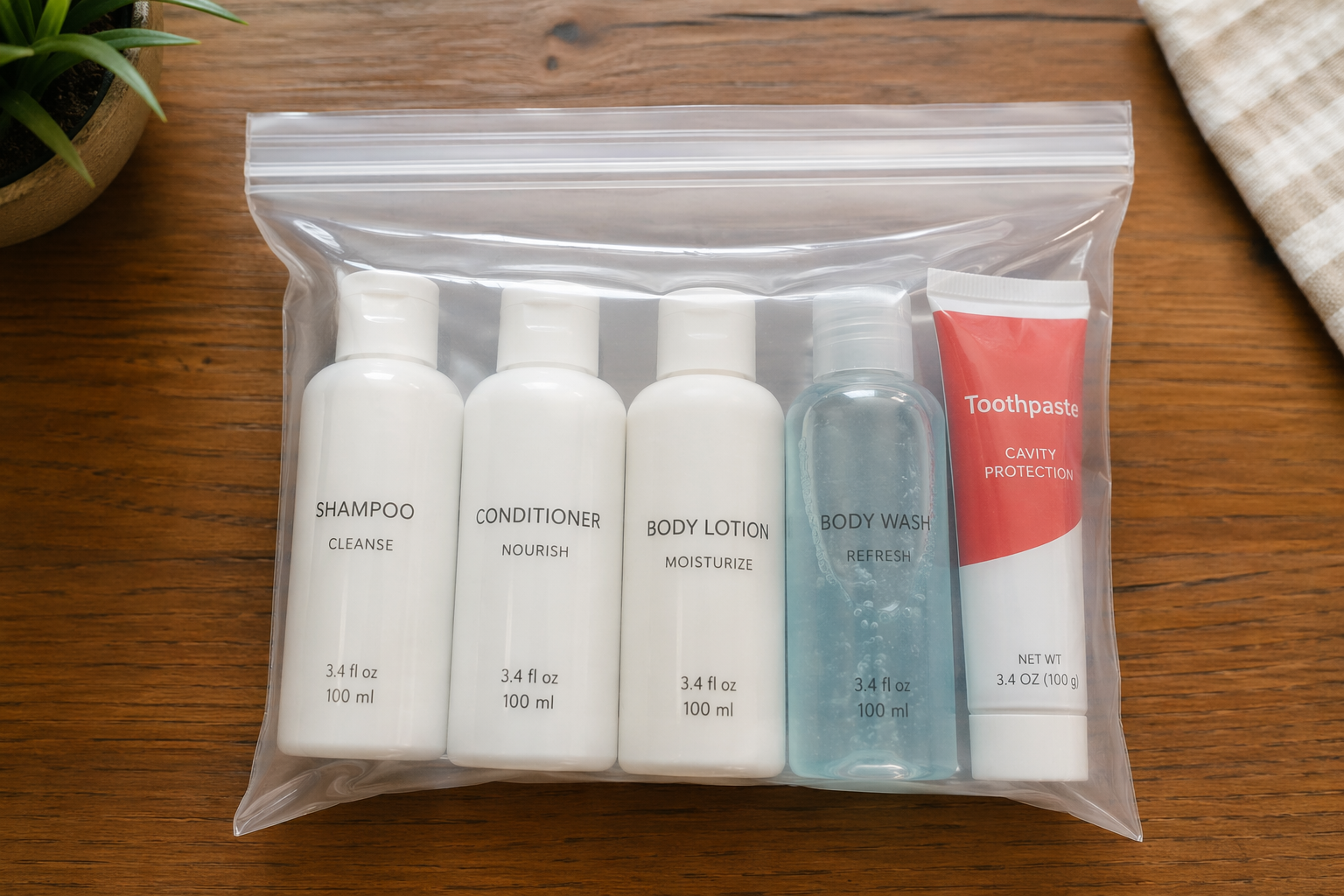
The 3-1-1 Rule, Without the Packing-Table Guesswork
For a normal carry-on toiletry kit, use this as the working rule:
- 3.4 oz / 100 ml per container, not per amount remaining inside the container.
- 1 clear quart-sized bag for all carry-on liquids, aerosols, gels, creams, and pastes.
- 1 bag per passenger.
TSA describes the quart bag as approximately 7 by 8 inches, which is helpful because “quart-sized” has become a vague kitchen-drawer phrase for many travelers.[1] If the bag is bulging so badly that it will not close, assume it will cause trouble. The rule is not “as many mini bottles as you can balance in a gray bin.”
Checked baggage is different. The 3-1-1 limit is a carry-on checkpoint rule. Full-size shampoo, sunscreen, lotion, and similar toiletries usually go in checked luggage, subject to any separate airline, hazardous-material, or product-specific restrictions. For carry-on packing, the question is simpler: is it liquid-like, is the container 3.4 oz / 100 ml or smaller, and does it fit in the one quart bag?
| Packing question | Practical answer |
|---|---|
| Can I bring a 6 oz bottle that is almost empty? | Not under the regular 3-1-1 rule. TSA looks at container size, not how much is left. |
| Can I bring several 3.4 oz bottles? | Yes, if they all fit in your one clear quart-sized bag. |
| Can my travel companion use their own quart bag? | Yes. The rule is one quart-sized bag per passenger. |
| Can I keep a full-size liquid in my carry-on if it is medically necessary or otherwise exempt? | Possibly, but it must fit the conditions for that exemption and may need to be declared or screened separately. |
What Counts as a Liquid Is Broader Than the Word Sounds
The checkpoint test is not whether you would call something a drink. A useful TSA packing test is whether the item is spreadable, pourable, pumpable, or squeezable. If it is, treat it as a liquid, gel, cream, paste, or aerosol for carry-on purposes.
That is why peanut butter, hummus, yogurt, jam or jelly, mascara, liquid lipstick, gel deodorant, and toothpaste all live under the same basic liquids logic in TSA’s item list.[3] None of those items feels like airport contraband when you are standing in your kitchen or bathroom. At the checkpoint, the form matters more than the grocery category.
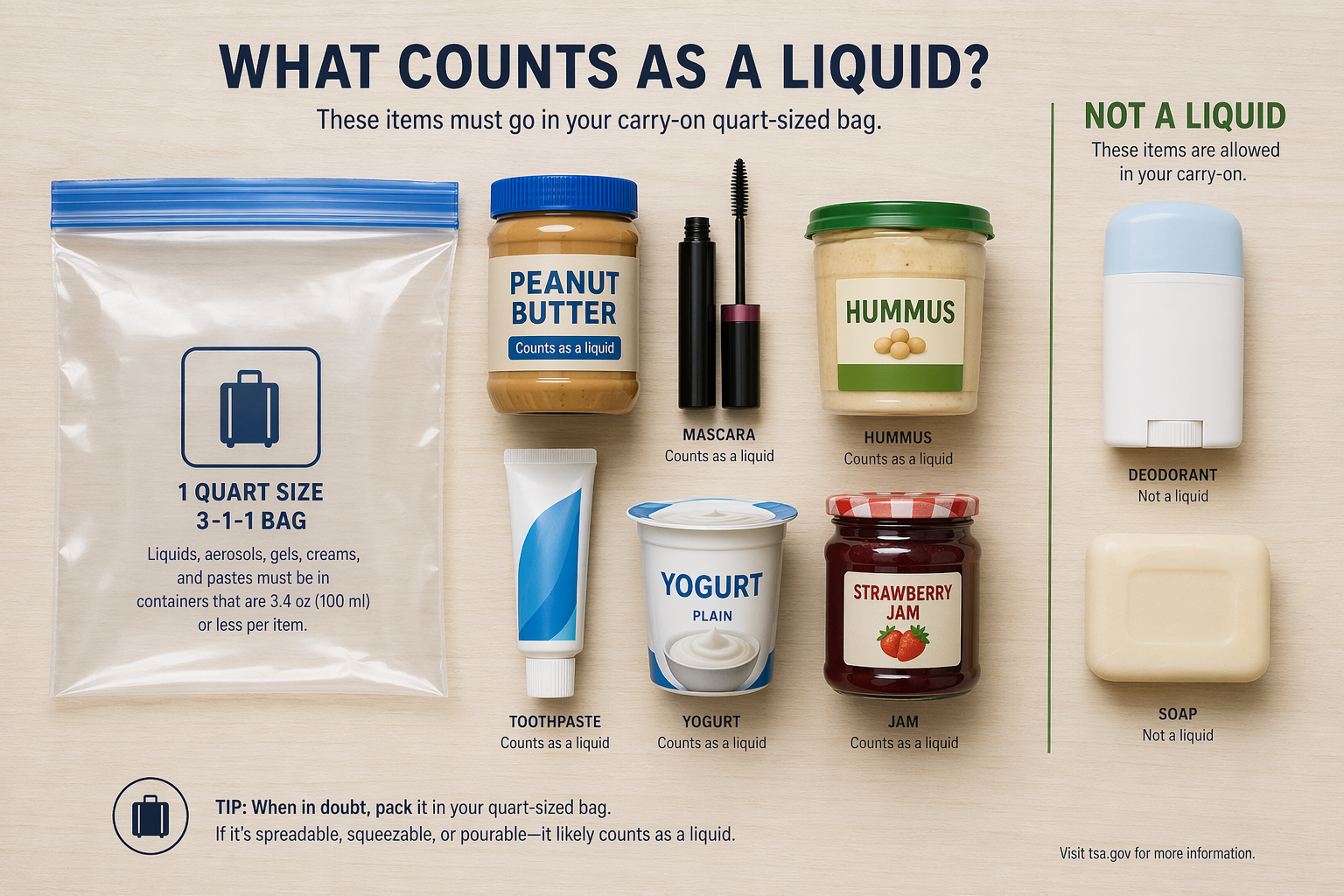
Food is where this rule catches many people because the item may feel solid until someone spreads it with a knife. Peanut butter and hummus are not treated like a sandwich. Yogurt is not treated like a granola bar. Jam or jelly is not treated like a sealed snack just because it came from a breakfast buffet. If the container is larger than 3.4 oz / 100 ml and it is not covered by an exemption, it should not be in your carry-on.
Makeup and toiletries create the same problem in smaller packaging. Mascara, liquid lipstick, gel deodorant, toothpaste, creams, lotions, sprays, gels, and pastes need to fit the quart bag if they are going through under the regular rule.[3] A cosmetic bag inside your backpack is not a substitute for the clear quart bag if a lane requires liquids to be removed.
True solids are the easiest way to buy back space. Solid deodorant, bar soap, solid lipstick, powder makeup, and dry shampoo bars are not the same problem as their gel, cream, spray, or liquid versions in TSA’s item list.[3] For a short trip, swapping one gel product for a solid version may matter more than buying a more elaborate toiletry organizer.
A Fast Sorting Test Before You Zip the Bag
- If you can pour, pump, spray, squeeze, smear, or spread it, start by treating it as a 3-1-1 item.
- If the container is larger than 3.4 oz / 100 ml, move it to checked baggage unless an exemption applies.
- If it is a true solid, keep it outside the quart bag unless the specific item has another restriction.
- If you are unsure about one specific item, use PackSmart’s can-i-bring lookup rather than guessing from a broad category name.
Full-Size Liquids Are Allowed Only When an Exemption Actually Applies
The exemptions are not a loophole for a favorite full-size conditioner. They exist for specific situations: medical need, infant and toddler feeding, certain duty-free purchases, and a handful of tightly conditioned edge cases. The useful question is not “Can any liquid be bigger?” It is “What do I need to do at the checkpoint so this particular larger liquid is screened correctly?”
Medications: Bring a Reasonable Quantity and Declare Them
TSA allows medically necessary liquids, gels, and aerosols in reasonable quantities for your trip, and they do not have to fit inside the quart-sized bag.[4] This includes prescription liquid medications and over-the-counter liquid medications when they are medically necessary. The action item is simple: tell the TSA officer at the start of screening that you are carrying medically necessary liquids.
Do not bury medication under a week of clothes and hope no one asks. Separate it in a way that makes screening easier. TSA may need to inspect, test, or otherwise screen the item, and the line moves better when the officer can see what you are declaring. Medically necessary accessories such as gel ice packs may also be allowed, including when they are melted, if they are needed to cool medically necessary items.[4]
Baby Formula, Breast Milk, and Toddler Feeding Items: Necessary Does Not Mean Tiny
Baby formula and breast milk are allowed in carry-on baggage in quantities greater than 3.4 oz / 100 ml, and TSA says they do not need to fit within a quart-sized bag.[5][6] TSA also states that you do not need to travel with your child to bring breast milk.[6] That point matters for pumping parents, caregivers, and anyone transporting milk separately from the child.
Separate these items from the rest of your belongings and tell the officer before screening begins.[5][6] Cooling accessories for baby formula and breast milk, including ice packs, freezer packs, and gel packs, are allowed; TSA notes they may be frozen, partially frozen, or slushy.[5][6] The likely delay is not because the item is forbidden. It is because it needs its own screening path.
Toddler drinks and food pouches can also be larger than 3.4 oz / 100 ml when they fall under TSA’s child-feeding allowances, but they should be presented for screening rather than hidden inside the regular liquids bag.[3] Liquid-filled teethers are also treated as allowed items in TSA’s list.[3]
Duty-Free Liquids: The Bag and Receipt Matter
Duty-free liquids larger than 3.4 oz / 100 ml may be allowed in carry-on baggage when they were purchased internationally, are packed in a secure tamper-evident bag, and you have a receipt showing the purchase was made within the previous 48 hours.[7] This is mainly an inbound international travel issue, not a permission slip to bring any oversized bottle through your home airport checkpoint.
If the tamper-evident bag has been opened, the receipt is missing, or the purchase does not fit the timing condition, expect trouble. Pack it in checked baggage when you can, especially if you have a connection and do not want a bottle bought after one flight to become a problem before the next one.
Frozen Items: Frozen Solid Means Frozen Solid
Frozen food and freezer packs are allowed through TSA only when they are frozen solid at screening. If they are partially melted, slushy, or have liquid at the bottom of the container, they must meet the regular 3-1-1 liquid requirements unless another exemption applies.[3] This is one of those rules that changes while you are in traffic to the airport, so pack accordingly.
There is a separate path for cooling medically necessary items and for cooling baby formula or breast milk. Those cooling accessories can be allowed even when not frozen solid if they are tied to the exempt item.[4][5][6] A random soft ice pack for snacks does not get the same treatment.
Edge Cases: Allowed, but Only Inside Their Conditions
A few unusual items sit outside the everyday toiletry problem. TSA’s list includes fresh eggs, live fish in water, live coral in water, non-infectious biological specimens in preservative solution, and non-spillable wet batteries, but each comes with conditions or additional limits.[3] For biological specimens, FAA limits include no more than 30 ml of free liquid solution in each inner packaging and no more than 1 liter in the outer packaging.[3] Non-spillable wet batteries are limited to 12 volts or less and 100 watt hours or less, with no more than two spare batteries.[3]
Most travelers will never pack those items. If you are one of the few who will, do not use a general liquids article as your only authority. Check the exact TSA item entry, the airline’s policy, and any FAA or destination rules that apply.
Hand Sanitizer Is Back Under the Regular Rule
The pandemic-era allowance that let travelers bring larger hand sanitizer containers through the checkpoint has ended. Hand sanitizer now follows the standard 3-1-1 carry-on rule: 3.4 oz / 100 ml or smaller, inside the quart-sized bag, unless another specific exemption applies.[3]
This is a good example of why old travel advice ages badly. A rule can be real for a period of time, then stop being the rule. For 2026 packing, do not give hand sanitizer special treatment unless TSA publishes a new exception.
CT Scanners May Change the Bin Routine, Not the Liquid Limit
New checkpoint CT scanners are the reason many travelers think the TSA liquid rules have quietly changed. The screening experience can be different. At CT-equipped checkpoints, travelers may often be told to leave liquids and electronics inside the bag. At traditional X-ray lanes, travelers may still need to remove the quart-sized liquids bag for screening. The packing limit remains the same either way.
Forbes reported in September 2025, citing TSA data, that CT scanners had been deployed at about 285 of 435 airports with screening checkpoints, with 1,027 units in use.[8] Those figures help explain the uneven experience: some airports and lanes feel modernized; others still work like the checkpoint many travelers remember. Exact 2026 airport and unit counts would need current TSA verification.
TSA’s procurement record also shows why the rollout is a long project, not a switch flip. TSA announced in April 2023 that it had awarded up to $1.3 billion to procure additional CT X-ray scanners for airport checkpoints.[9] Forbes also reported $2.2 billion in spending from 2021 through 2023 on the technology.[8]
The policy reason is straightforward: a national rule cannot safely depend on travelers guessing which airport, terminal, lane, machine, or officer they will encounter. Jeff Price of Denver International Airport and MSU Denver told Forbes that full deployment needs to reach 100 percent before rules can change nationally, to avoid security gaps.[8]
There has been public talk about future changes. Forbes reported that DHS Secretary Kristi Noem said in July 2025 that liquids “may be the next big announcement,” but no official TSA rule change had been published as of mid-2026.[8] Condé Nast Traveler has noted that some estimates point as far out as 2040 for a full repeal, but that should be treated as an unconfirmed projection rather than an official TSA deadline.[10]
Europe is not a clean shortcut either. Some European airports tested or introduced relaxed liquid limits with newer scanners, but the broader EU rollout was pushed back after technical issues, and conditions have varied by airport.[10] That comparison is useful mainly as a warning: scanner technology can improve faster than uniform passenger rules do.
How to Pack for 2026 Without Slowing Down the Line
Pack as if the 3-1-1 rule applies everywhere, because for the liquid limit it does. If your airport has CT scanners, you may get the easier version of the bin routine. If it does not, or if your lane is using traditional X-ray screening, you will be ready anyway.
- Put regular toiletries in containers of 3.4 oz / 100 ml or smaller.
- Fit all regular liquids, gels, creams, pastes, and aerosols into one clear quart-sized bag.
- Move full-size non-exempt liquids to checked baggage.
- Separate medications, baby formula, breast milk, toddler feeding items, and related cooling accessories before screening.
- Keep duty-free liquids sealed in the required tamper-evident bag with the receipt if you plan to carry them through a connecting checkpoint.
- Do not assume a CT scanner, TSA PreCheck, CLEAR, or a short line changes the 3.4 oz container limit.
The cleanest packing decision is often boring: travel-size containers for liquid-like items, solids where they make sense, and deliberate separation for anything exempt. Future repeal talk can wait until TSA publishes an actual rule change.
References
- Liquids, Aerosols, and Gels Rule — TSA.gov
- Travel Checklist — TSA.gov
- Complete Item List — TSA.gov
- Medical items — TSA.gov
- Baby Formula — TSA.gov
- Breast Milk — TSA.gov
- Liquids FAQ — TSA.gov
- When Will The TSA Get Rid Of The Liquids Rule? — Forbes, September 19, 2025
- TSA awards up to $1.3 billion to procure additional CT X-ray scanners — TSA.gov, April 12, 2023
- TSA Lets You Bring These 11 Full-Size Liquids Through Airport Security — Condé Nast Traveler
Spotted something outdated?
Report a correction if this explainer no longer matches the current rule. Report a correction.