
Can You Bring Food on a Plane? Yes, With These TSA Limits
Packing snacks or a meal for your flight? Get the TSA verdict on solid foods, liquids, baby food, and alcohol, with a clear table showing what's allowed in carry-on and checked bags.
- Carry-on
- CONDITIONAL
- Checked bag
- CONDITIONAL
- Regulating agency
- TSA
- Official source
- View the official TSA rule
Rule last reviewed:
TSA and CBP officers retain final discretion at the checkpoint, even when this verdict is correct.
- YES — allowed
- NO — not allowed
- CONDITIONAL — depends on the details
- CHECKED BAG ONLY — not in carry-on
Yes, you can bring food on a plane in both carry-on and checked bags in most cases. The fast TSA rule is this: solid food is usually allowed with no TSA size limit, while liquid, gel, creamy, or spreadable food must follow the 3-1-1 liquids rule in carry-on bags if it is over 3.4 oz. Alcohol over 140 proof is not allowed at all, and fresh fruits and vegetables from Hawaii, Puerto Rico, and the U.S. Virgin Islands cannot be brought to the mainland because of agricultural restrictions. TSA also states that the final decision rests with the officer at the checkpoint. [1]
| Bag | General TSA verdict | What changes the answer |
|---|---|---|
| Carry-on | Yes for most solid foods | Creamy, spreadable, pourable, gel-like, or saucy foods must be 3.4 oz or less and fit in the quart-size liquids bag unless an exemption applies. [1] |
| Checked bag | Yes for most foods, including larger liquid or spreadable foods | Alcohol limits, dry ice rules, agricultural restrictions, and airline rules can still apply. [1] |
| Not allowed | Certain items are prohibited regardless of bag | Alcohol over 140 proof is banned; fresh produce from Hawaii, Puerto Rico, and the U.S. Virgin Islands to the mainland is restricted. [1][2] |
The Five-Second Food Test
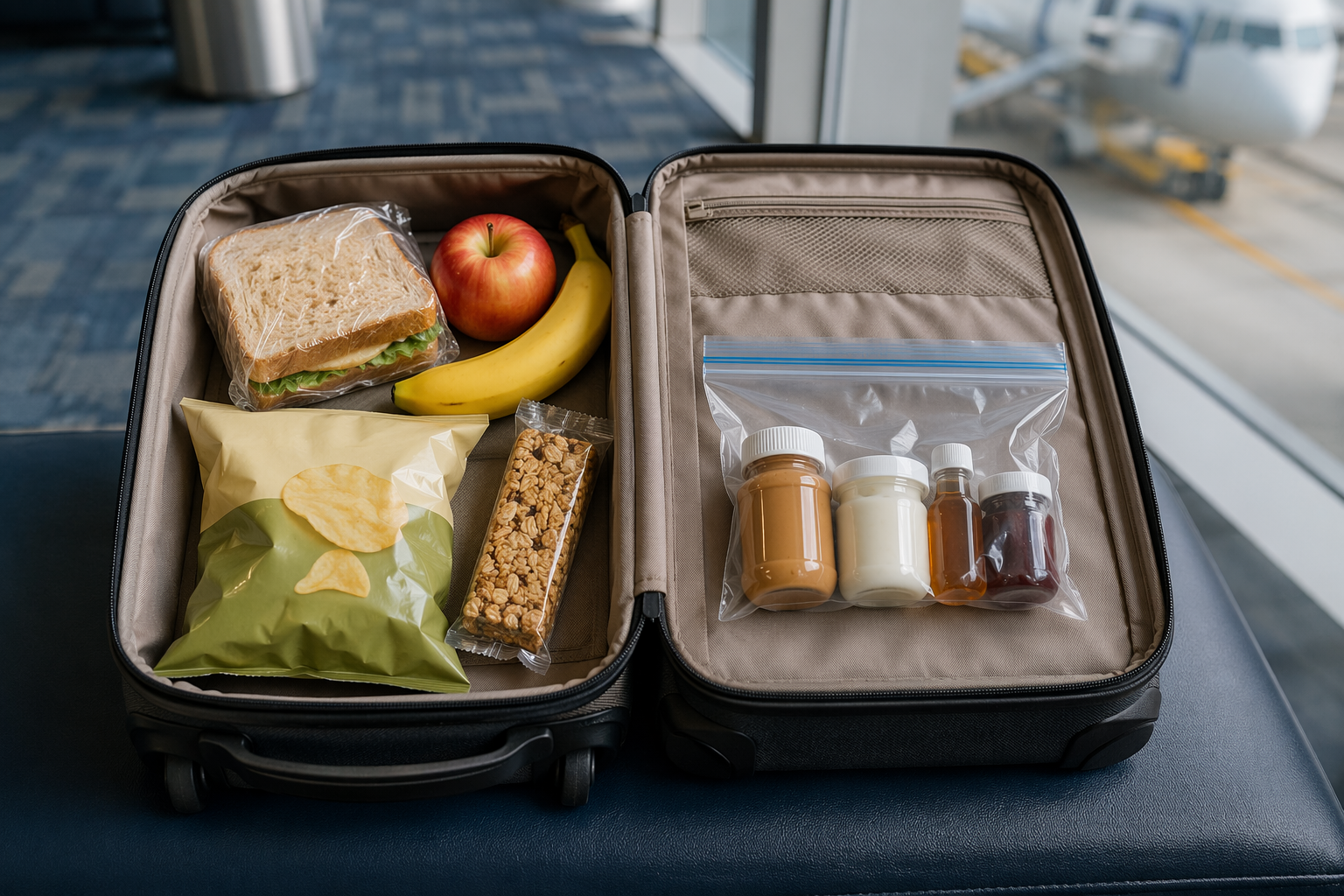
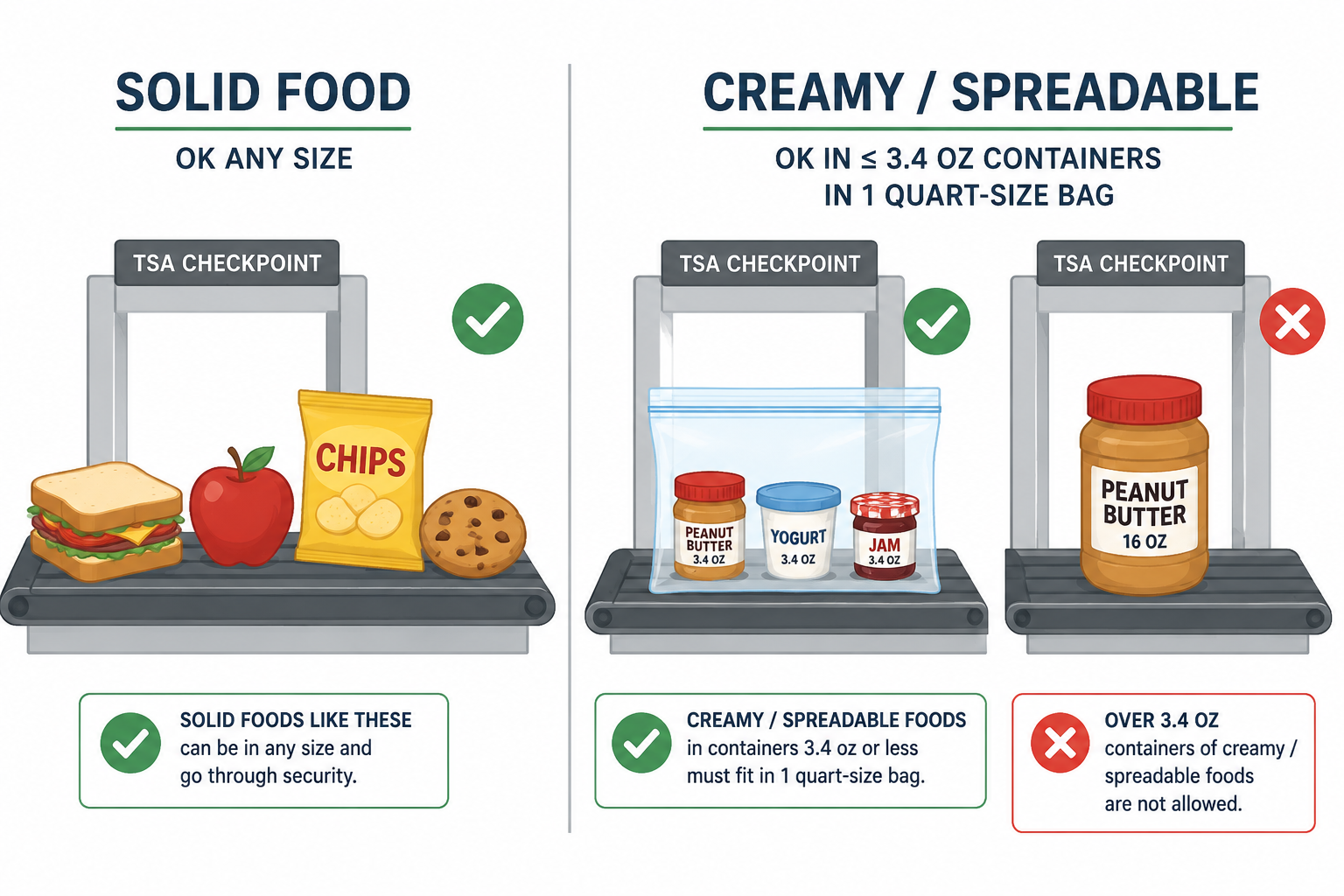
If the food keeps its shape when you turn it sideways, it is usually easy: sandwich, pizza slice, chips, cookies, fruit, candy, protein bar, burger, hard-boiled egg. If it spreads, pours, oozes, smears, or sits in a sauce, treat it like a liquid for carry-on screening: peanut butter, hummus, yogurt, jam, honey, maple syrup, salsa, gravy, soup, salad dressing, cream cheese, frosting, and Nutella. TSA’s food list applies that distinction across common items. [1]
That does not mean the food is forbidden. It means the container matters. A 3.4 oz travel container of peanut butter in the quart bag can go through carry-on screening; a full-size jar should go in checked luggage or stay home. For foods not listed by name, TSA’s alphabetical “What Can I Bring?” list is the next place to check. [3]
Food Item Lookup Table
Use the table by physical form, not by whether the food feels like a snack, meal, souvenir, or leftover. A cookie is simple. A jar of cookie butter is not. A block of cheddar is simple. Spreadable cheese is not.
| Food item | Carry-on | Checked bag | Limit or condition |
|---|---|---|---|
| Sandwich | Allowed | Allowed | Solid food; no TSA size limit. [1] |
| Whole fruit, such as apple, banana, or orange | Allowed on most mainland U.S. routes | Allowed on most mainland U.S. routes | Fresh produce from Hawaii, Puerto Rico, and the U.S. Virgin Islands to the mainland is restricted. [2] |
| Cut vegetables | Allowed on most mainland U.S. routes | Allowed on most mainland U.S. routes | Fresh produce from Hawaii, Puerto Rico, and the U.S. Virgin Islands to the mainland is restricted; sauces or dips packed with vegetables must follow the liquid rule in carry-on. [1][2] |
| Chips or crackers | Allowed | Allowed | Solid snack; no TSA size limit. [1] |
| Cookies or brownies | Allowed | Allowed | Solid baked goods; no TSA size limit. [1] |
| Candy | Allowed | Allowed | Solid candy is allowed; liquid-filled or gel candy may receive closer screening. [1] |
| Pizza | Allowed | Allowed | Solid food; no TSA size limit. [1] |
| Burger | Allowed | Allowed | Solid food; no TSA size limit. [1] |
| Hard-boiled eggs | Allowed | Allowed | TSA lists eggs as allowed in carry-on and checked bags. [1] |
| Raw eggs | Allowed | Allowed | Allowed by TSA, but fragile and messy; pack against breakage. [1] |
| Yogurt | Allowed only if 3.4 oz or less in the liquids bag | Allowed | Creamy food; carry-on containers over 3.4 oz are not allowed unless covered by a baby/toddler exemption. [1] |
| Peanut butter | Allowed only if 3.4 oz or less in the liquids bag | Allowed | Spreadable food; full-size jars belong in checked bags. [1] |
| Hummus | Allowed only if 3.4 oz or less in the liquids bag | Allowed | Spreadable dip; larger containers are checked-bag items. [1] |
| Jam or jelly | Allowed only if 3.4 oz or less in the liquids bag | Allowed | Gel/spread; the container size controls the carry-on answer. [1] |
| Honey | Allowed only if 3.4 oz or less in the liquids bag | Allowed | Pourable food; larger containers should be checked. [1] |
| Maple syrup | Allowed only if 3.4 oz or less in the liquids bag | Allowed | Liquid food; larger bottles should be checked. [1] |
| Salad dressing | Allowed only if 3.4 oz or less in the liquids bag | Allowed | Liquid or creamy dressing follows 3-1-1 in carry-on. [1] |
| Salsa | Allowed only if 3.4 oz or less in the liquids bag | Allowed | Saucy food; large jars should be checked. [1] |
| Gravy | Allowed only if 3.4 oz or less in the liquids bag | Allowed | Liquid/sauce; carry-on containers over 3.4 oz are not allowed. [1] |
| Soup | Allowed only if 3.4 oz or less in the liquids bag | Allowed | Liquid food; a meal-size container is a checked-bag item. [1] |
| Cream cheese | Allowed only if 3.4 oz or less in the liquids bag | Allowed | Spreadable cheese follows the liquid rule in carry-on. [1] |
| Nutella or similar chocolate-hazelnut spread | Allowed only if 3.4 oz or less in the liquids bag | Allowed | Spreadable food; larger jars should be checked. [1] |
| Frosting | Allowed only if 3.4 oz or less in the liquids bag | Allowed | Creamy/spreadable food; full-size tubs are checked-bag items. [1] |
| Solid cheese block | Allowed | Allowed | Solid cheese is allowed; spreadable cheese is treated differently. [1] |
| Spreadable cheese | Allowed only if 3.4 oz or less in the liquids bag | Allowed | Creamy/spreadable food; follow 3-1-1 in carry-on. [1] |
| Chocolate bars | Allowed | Allowed | Solid candy; no TSA size limit. [1] |
| Nuts | Allowed | Allowed | Solid snack; no TSA size limit. [1] |
| Protein bars | Allowed | Allowed | Solid snack; no TSA size limit. [1] |
| Baby food pouches or jars | Allowed in reasonable quantities | Allowed | Exempt from the 3.4 oz limit when for babies or toddlers; remove from the bag and tell the officer. [4] |
| Baby formula | Allowed in reasonable quantities | Allowed | Exempt from the 3.4 oz limit; the child does not need to be present. [5] |
| Breast milk | Allowed in reasonable quantities | Allowed | Exempt from the 3.4 oz limit; the child does not need to be present. [6] |
| Frozen ice packs | Allowed if frozen solid | Allowed | If partially melted, slushy, or with liquid at the bottom, they must meet the 3.4 oz liquids rule unless used for exempt baby/toddler items. [1][5][6] |
| Dry ice | Allowed with limits | Allowed with limits | FAA rules limit dry ice to 5.5 lb per person, require airline approval, and require packaging that permits carbon dioxide gas release. [7] |
| Alcohol mini bottles | Allowed if 3.4 oz or less and in the liquids bag | Allowed if 140 proof or less | Carry-on alcohol must fit the liquids rule; alcohol over 140 proof is prohibited. [1] |
| Full bottles of alcohol | Not allowed in carry-on unless 3.4 oz or less | Allowed if 140 proof or less | Over 140 proof, or over 70% ABV, is banned from carry-on and checked bags. [1] |
| Canned foods | Technically allowed, but screening-prone | Allowed | TSA warns canned goods may require extra screening and may not be permitted through if they cannot be cleared. [1] |
| Foil-wrapped food | Allowed, but screening-prone | Allowed | Foil can make X-ray screening harder and may lead to a bag check. [8][9] |
| Fresh meat or seafood | Allowed if properly packed | Allowed if properly packed | Ice or ice packs must be completely frozen at screening; partially melted ice falls under liquid limits. [10] |
Baby Food, Formula, Breast Milk, and Toddler Drinks
Baby formula, breast milk, toddler drinks, and baby or toddler food are the major exception to the usual 3.4 oz carry-on limit. TSA allows these items in reasonable quantities, and they do not need to fit inside the quart-size liquids bag. TSA also says the child does not need to be traveling with you for formula and breast milk to be allowed. [4][5][6]
Pack these items so they can come out quickly at screening. Tell the officer before screening begins, separate them from the rest of the bag, and expect possible additional screening. That is not a penalty; it is the checkpoint doing the extra work required for an exempt liquid.
Ice packs, freezer packs, gel packs, and other cooling accessories for formula, breast milk, and baby or toddler food are allowed, even if they are partially frozen or slushy. That matters because the ordinary ice-pack rule is stricter. [4][5][6]
Frozen Food, Ice Packs, and Dry Ice
Frozen food can go through TSA if it is still frozen solid when screened. The same practical rule applies to ice packs: frozen solid is fine; partially melted, slushy, or liquid pooling at the bottom turns the item into a liquids-rule problem in carry-on. [1]
Dry ice has its own limit. FAA rules allow up to 5.5 lb per person when used to refrigerate perishables, but the airline must approve it, and the package must allow carbon dioxide gas to escape. The package also has to be marked with the contents and the net weight of dry ice. [7]
For ordinary leftovers, a fully frozen gel pack is usually simpler than dry ice. Dry ice is for the cases where the cooling method is worth coordinating with the airline before you leave for the airport.
Alcohol Is Food-Adjacent, but the Rule Is Different
Alcohol under the TSA carry-on rule still has to fit the liquids limit: containers of 3.4 oz or less, packed in the quart-size bag. That covers mini bottles, not a standard bottle of wine, liquor, or liqueur. In checked bags, alcohol is allowed only if it is 140 proof or less. Anything over 140 proof, or over 70% alcohol by volume, is prohibited in both carry-on and checked luggage. [1]
The screening answer is not the same as the drinking-on-board answer. Bringing a permitted mini bottle through TSA does not mean you can serve yourself during the flight; airline and federal aviation rules control alcohol consumption onboard.
Cans, Foil, and Other Items That Are Allowed but Annoying
Some foods are technically permitted but bad carry-on candidates. Canned foods are the clearest example. TSA lists them as allowed, but also warns that they may require extra screening because of how they appear on X-ray, and that the item may not be allowed through if it cannot be cleared. [1]
Foil-wrapped food has a similar problem. A burrito, sandwich, or leftovers wrapped in foil is not automatically prohibited, but foil can block or complicate the X-ray image and trigger a bag inspection. Travel + Leisure and AFAR both flag foil as a common reason food draws extra scrutiny at the checkpoint. [8][9]
If the item is dense, canned, foil-wrapped, frozen, or packed inside a cooler, put it where it can be removed quickly. The goal is not to make the argument perfectly; it is to make the officer’s screening decision easier.
TSA Is Not Customs
For domestic mainland U.S. flights, TSA screening is usually the main food hurdle. For international flights, it is only the first one. A food item can be allowed through TSA and still be restricted or confiscated by customs or agriculture officials when you arrive. Fresh fruit, vegetables, meat, dairy, seeds, and plant products are the categories most likely to create arrival problems.
There is also a U.S.-specific produce rule that applies before any international question comes up: TSA says fresh fruits and vegetables cannot be transported from Hawaii, Puerto Rico, or the U.S. Virgin Islands to the U.S. mainland because of invasive plant pest risk. [2]
Fresh meat and seafood are allowed by TSA in carry-on and checked bags if packed properly, but cooling materials must still satisfy the frozen-solid rule at screening. That TSA permission does not answer whether another country, or the U.S. on reentry, will allow the food through agriculture inspection. [10]
About Larger Liquid Rules at Some Non-U.S. Airports
Some travelers have seen reports about newer scanners and larger liquid allowances at certain airports outside the United States. That does not change the packing rule for a U.S. TSA checkpoint. As of July 2026, use the 3.4 oz carry-on limit for liquid, gel, creamy, and spreadable foods unless a TSA exemption applies. [1]
The Packing Decision
Pack solid food in carry-on if you want it during the trip. Pack spreadable, creamy, saucy, or pourable food in 3.4 oz containers inside the quart bag, or move it to checked luggage. Use the baby and toddler exemption when it applies, keep cooling packs frozen solid unless they are for exempt baby items, and do not try to carry alcohol over 140 proof.
For borderline food, make the bag easy to inspect: separate the item, avoid foil when another wrapper works, and keep labels visible. A permitted item still has to clear the checkpoint in front of you.
References
- Food — Transportation Security Administration
- Fresh Fruits and Vegetables — Transportation Security Administration
- Complete List (Alphabetical) — TSA
- Baby Food — Transportation Security Administration
- Baby Formula — Transportation Security Administration
- Breast Milk — Transportation Security Administration
- Can You Bring Food Through TSA? — NerdWallet, May 2026
- Travel + Leisure (May 2026) — Travel + Leisure, May 2026
- Can You Bring Food Through TSA? — AFAR, September 2025
- Fresh Meat and Seafood — Transportation Security Administration
See something outdated?
If this verdict, citation, or figure looks out of date, let us know. Report a correction.