
How Much Cash Can You Fly With?
TSA does not limit cash on domestic flights, but a $10,000 reporting rule applies internationally. Learn the exact thresholds, what counts as cash, and the penalties for not declaring.
- Carry-on
- Not specified
- Checked bag
- Not specified
- Regulating agency
- TSA
- Official source
- View the official TSA rule
Rule last reviewed:
TSA and CBP officers retain final discretion at the checkpoint, even when this verdict is correct.
- YES — allowed
- NO — not allowed
- CONDITIONAL — depends on the details
- CHECKED BAG ONLY — not in carry-on
Conditional verdict: you can fly with cash, but the rule changes at the border. On a domestic U.S. flight, TSA does not set a cash limit and there is no domestic cash declaration form. On an international trip into or out of the United States, you must report when your family or group is carrying more than $10,000 in combined currency or monetary instruments by filing FinCEN Form 105 with CBP.[1][2][3]
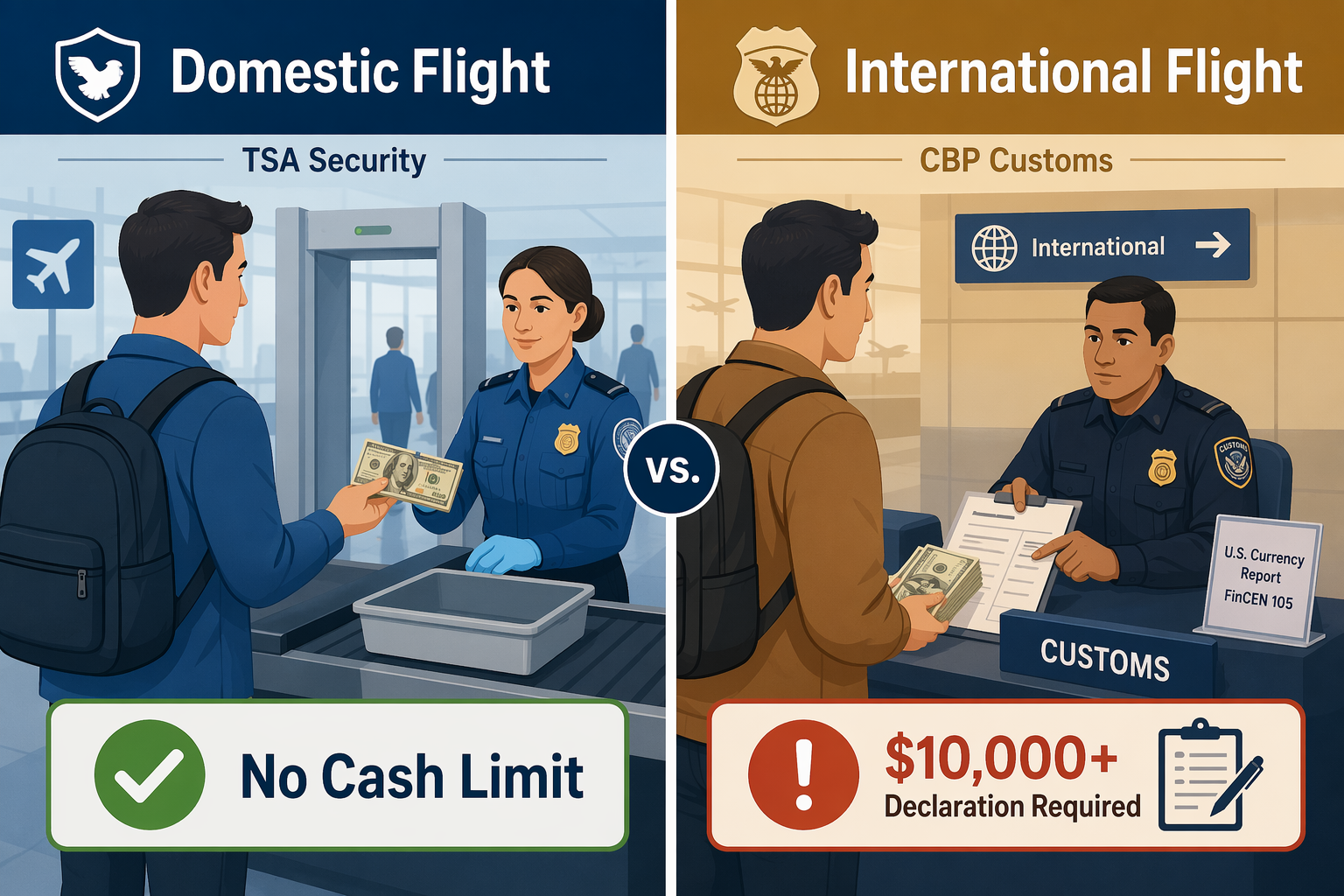
That is the part hidden inside the phrase people repeat at airports: “the $10,000 limit.” It is not a TSA carry limit. It is not a rule that makes $10,001 illegal. It is a CBP reporting trigger for international travel, and failing to report can turn lawful money into seized money.
| Trip type | How much cash can you fly with? | What you must do |
|---|---|---|
| Domestic flight within the U.S. | No TSA cash limit | Cash is not prohibited by TSA; no domestic declaration form applies |
| Entering or leaving the U.S. | Any amount is legal to carry | Declare if the combined family or group total exceeds $10,000 |
| International trip at or below $10,000 | No U.S. cash declaration required under the CBP threshold | Keep in mind that the destination country may have its own rule |
| International trip over $10,000 | Allowed, but reportable | File FinCEN Form 105 with CBP |
The Clean Split: TSA Screens Bags, CBP Enforces the Cash Report
TSA’s job at the checkpoint is transportation security: screening for weapons, explosives, incendiaries, and other prohibited items. Cash is not on TSA’s prohibited-items list, and TSA’s authority is not a general authority to cap how much money a traveler may possess.[1][2]
That does not mean a stack of cash moves through an airport like a paperback. If screeners see a large amount of money during routine screening, the practical consequence may be more questions or a referral to another agency. The legal point is narrower: TSA itself is not the agency that created a domestic dollar limit, because there is no domestic TSA cash limit to create.
CBP is the agency that matters when your trip crosses the U.S. border. CBP says travelers entering or leaving the United States must report more than $10,000 in currency or other monetary instruments, and the report is made on FinCEN Form 105.[3]
How the $10,000 International Rule Actually Works
The threshold is more than $10,000. A traveler carrying exactly $10,000 is not over that U.S. reporting threshold. A traveler, family, or group carrying more than $10,000 combined while entering or leaving the United States must declare it.[3]
The combined part matters. The rule is not a private $10,000 allowance for each person in the same traveling party. CBP describes the reporting duty by family or group, which means splitting money among spouses, relatives, or companions does not make the reporting requirement disappear if the combined total exceeds the threshold.[3]
The direction of travel matters, too. This is not only an arrival rule for visitors landing in the United States. CBP applies the reporting requirement when travelers enter or leave the country with more than $10,000 in covered money or monetary instruments.[3]
What Counts Toward the Total
For this rule, “cash” is too small a word. CBP’s monetary-instruments rule includes U.S. currency, foreign currency, traveler’s checks, money orders, bearer bonds, and negotiable instruments endorsed without restriction.[3]
- Count U.S. dollars and foreign currency together.
- Count traveler’s checks and money orders if they fall within the covered monetary-instrument categories.
- Count bearer bonds and certain negotiable instruments, not just bills in an envelope.
- Count the family or group total, not only the amount in your own wallet.
The reporting requirement is not a tax by itself and not an accusation by itself. It is paperwork that tells the government what is crossing the border. The trouble begins when a traveler treats the form as optional because the money is legitimate, or because the money is divided among people in the same party.
What Happens If You Do Not Declare It
If you are required to report and do not, the consequences are not limited to a lecture at the customs counter. Reported penalties include seizure of all funds, civil fines up to $500,000, and criminal penalties that can include up to 10 years in federal prison.[4]
This is where “but the money is mine” is not enough protection at the airport. Legitimate source and legitimate purpose matter, but they may have to be proved after the money has already been detained or seized. Civil forfeiture procedures can put the burden on the traveler to contest the seizure and show why the funds should be returned.[5][6]
The scale is not theoretical. Legal analyses cited here report federal agencies collecting $4.2 billion through forfeiture in 2021 and describe CBP currency seizures in the tens of millions annually, including a roughly $65 million annual figure and an about $300,000-per-day estimate.[5][6]
Those figures should be read carefully. The $4.2 billion number is from 2021, and forfeiture totals vary. They do not mean every traveler with cash will lose it. They do show why a declaration rule should not be treated like a casual airport preference.
Domestic Flights: No TSA Cap, Still Not Always Frictionless
For a domestic flight within the United States, there is no TSA rule that limits you to $10,000, $20,000, or any other amount of cash. There is also no domestic equivalent of FinCEN Form 105 just because you are flying from one U.S. city to another.[1][2]
The risk on a domestic trip is different from the international declaration risk. TSA cannot legally seize cash merely because it is cash, but screeners who discover large sums may notify DEA, CBP, Homeland Security Investigations, or local police. Those agencies may ask questions, investigate, or pursue seizure under their own authority.[5][6]
A 2024 Inspector General advisory reportedly led to suspension of the DEA’s airport seizure program, but that does not erase every airport cash-seizure risk. CBP, HSI, and local law enforcement can operate under separate authority, and state procedures vary.[6]
For domestic travelers carrying large legitimate funds, the practical distinction is this: you are not violating a TSA cash limit, because there is no such limit. But you may still want records that explain the source and purpose of the money if another agency starts asking questions.
International Flights: The Form Is the Line
On an international trip, the safest way to think about the rule is not “How do I stay under the limit?” It is “Am I over the reporting threshold?” Carrying more than $10,000 is allowed, but it must be reported when you enter or leave the United States.[3]
FinCEN Form 105 is the reporting mechanism. If your family or group total is over $10,000, the form is not optional paperwork and not something reserved for commercial importers. It applies to travelers carrying covered currency or monetary instruments across the U.S. border.[3]
The common mistakes are predictable: counting only U.S. dollars, forgetting foreign currency, assuming each person gets a separate threshold, or treating traveler’s checks and money orders as outside the rule. CBP’s definition is broader than bills and coins in a wallet.[3]
This Is U.S. Guidance, Not a Global Cash Rule
This article addresses U.S. TSA and CBP rules. Other jurisdictions use their own thresholds and forms. The U.K., EU, Canada, and Australia, for example, have separate cash-reporting regimes with thresholds stated in their own currencies. Do not assume the U.S. $10,000 rule is the rule at your destination.
For the U.S. side of the trip, the classification is straightforward: domestic flight, no TSA cash cap; international trip at or below the reporting threshold, no U.S. CBP cash report under this rule; international trip over $10,000 for the family or group, file FinCEN Form 105.
References
- How much money can you bring into and out of the U.S.? — USA.gov
- TSA Cash Limit Per Person — Strickland Webster, LLC
- Money and Other Monetary Instruments — U.S. Customs and Border Protection
- Flying with Cash Money — Alternative Airlines
- Can TSA Seize Cash? Understanding Your Rights When Traveling With Money — Meltzer & Bell
- Airport Cash Seized? Civil Forfeiture Guide — My Rights Law Group
See something outdated?
If this verdict, citation, or figure looks out of date, let us know. Report a correction.