
You have opened a Zi Wei Dou Shu calculator, entered a name and a birth date, and now the screen is asking about calendars, time zones, and an exact birth hour. Those fields can feel like administrative details, especially when all you want to see is what the stars say. They are not administrative details. The calculator removes much of the chart-building arithmetic, but it cannot repair uncertain or incorrectly converted birth data.
Before interpreting a star or palace, check whether the chart was generated from the right inputs. In Zi Wei Dou Shu, the birth hour is especially consequential: being one hour off can shift the Life Palace by a whole palace, and a chart without a birth hour does not stand up as a reliable basis for interpretation.[1]
Check the birth data before reading the chart
Start with the original birth record, not a remembered approximation. Write down the date, local clock time, and place of birth as they were recorded. If the time is uncertain, keep that uncertainty visible rather than choosing a convenient hour and treating the result as settled.
Confirm the calendar type
Most calculators require you to identify whether the date you entered is Gregorian or lunar. A date written on a civil birth certificate is normally a Gregorian calendar date, while a family record or traditional almanac may give a lunar date. Do not select the lunar option simply because Zi Wei Dou Shu uses traditional calendar calculations. Select the calendar type that matches the date you actually have, then let the calculator perform the conversion if it supports that workflow.
If you are converting the date yourself, verify the result against the calculator's displayed lunar date, heavenly stems and earthly branches, or other available output. A conversion can be wrong even when the original numbers look familiar. The problem becomes more delicate around a leap month, because a leap lunar month is not interchangeable with the regular month bearing the same number.
Treat the birth hour as a range, not just a number
Zi Wei Dou Shu commonly organizes the day into twelve two-hour periods called shichen. The calculator may show these periods by an animal name, a Chinese character, or a clock range. Choose the period that contains the recorded local birth time.
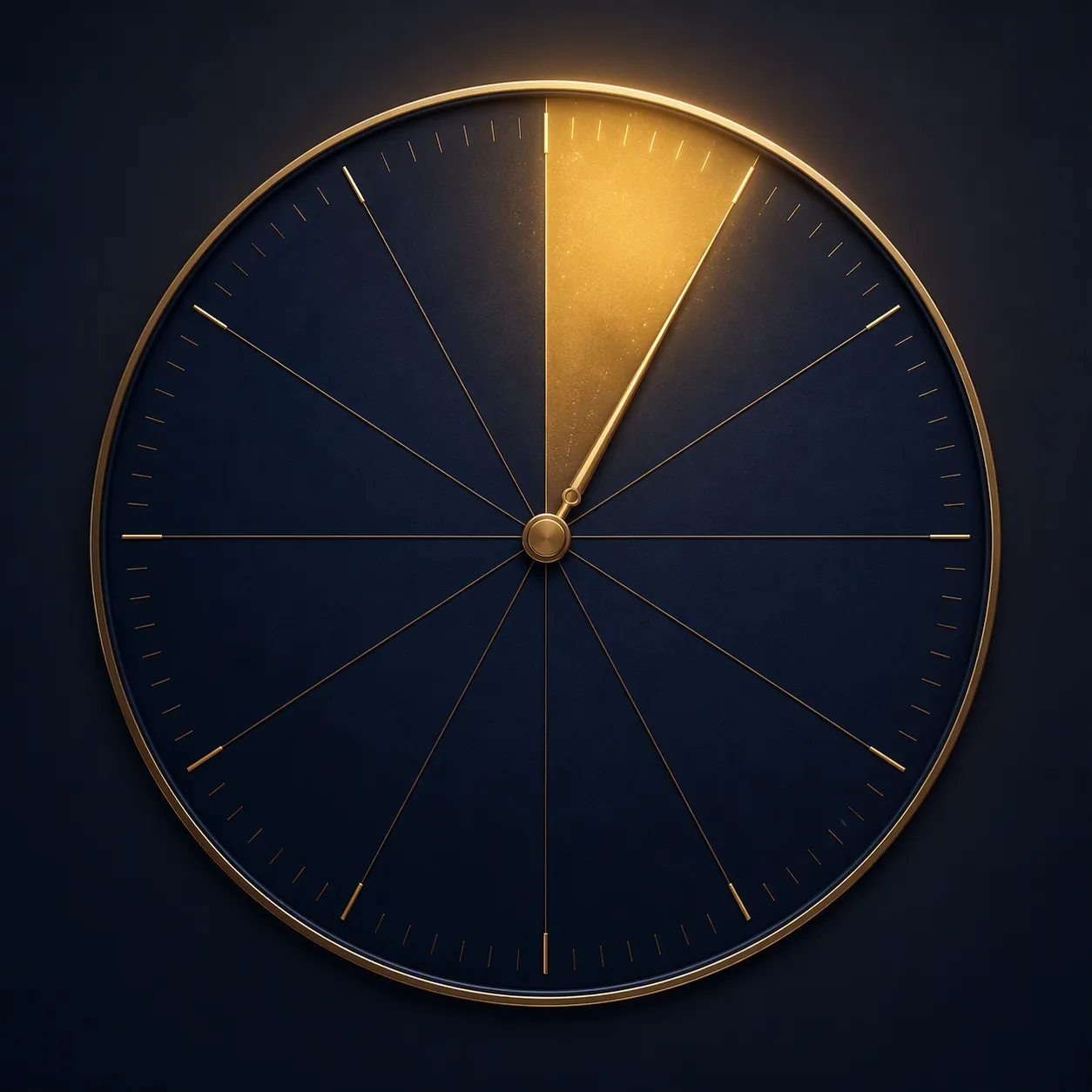
Pay particular attention to births near the boundary between two periods. A person born shortly before or after the boundary may receive a different chart if the time is rounded, remembered incorrectly, or entered in the wrong format. A one-hour mistake is enough to move the Life Palace by one palace, so an approximate hour should not be presented as an exact one.
The Zi hour creates an additional date problem. It spans 23:00 to 01:00, crossing midnight on the civil clock. Different systems can handle the day rollover differently, so check how the calculator labels dates during this interval. A birth at 00:30 may not be handled simply by selecting the previous day's date or by assuming that every calculator applies the same convention.
Check local time, time zone, and daylight saving
Enter the clock time used at the birthplace, then confirm the time-zone setting. A calculator may ask for a city, a UTC offset, or a location. These are related but not identical ways of describing local time. The relevant question is not where you live now; it is what local time was in effect where and when the birth occurred.
Daylight-saving time can change the conversion. If the birthplace observed daylight saving on the birth date, the displayed local clock time may need a different offset from the standard time used in winter. Check the historical setting for that date rather than applying today's offset automatically.
Some calculators also offer true solar time. This adjusts clock time according to the birthplace's longitude and the position of the local sun, rather than treating the entire time zone as one point. Whether the calculator applies this adjustment automatically, offers it as an option, or leaves it out entirely matters. Read the tool's setting and record which choice produced the chart.
For an ordinary birth well inside a two-hour period, a small time adjustment may not change the selected shichen. Near a boundary, it can. That is why true solar time is not a setting to toggle casually after the chart has already been interpreted.
- Use the correct calendar type for the date you possess.
- Enter the recorded local birth time, including minutes.
- Check the birthplace's historical time zone and daylight-saving status.
- See whether true solar time is required or enabled by the calculator.
- Verify the date rollover and leap-month setting when either applies.
- Save the settings used so another chart can be compared on the same basis.
If the birth hour is unknown, generate a chart only as a provisional comparison, not as a firm reading. You can test plausible time periods and note what changes, but the uncertainty belongs in the interpretation. A neatly rendered grid does not make an uncertain hour precise.
Read the twelve-palace output from the Life Palace outward
Once the inputs are checked, the generated chart becomes easier to approach. The twelve-palace grid is a map of connected life domains, not twelve independent fortune boxes. Its layout may look crowded because a calculator places palace names, stars, stems, branches, transformations, and luck information into the same small area. You do not need to decode every label at once.
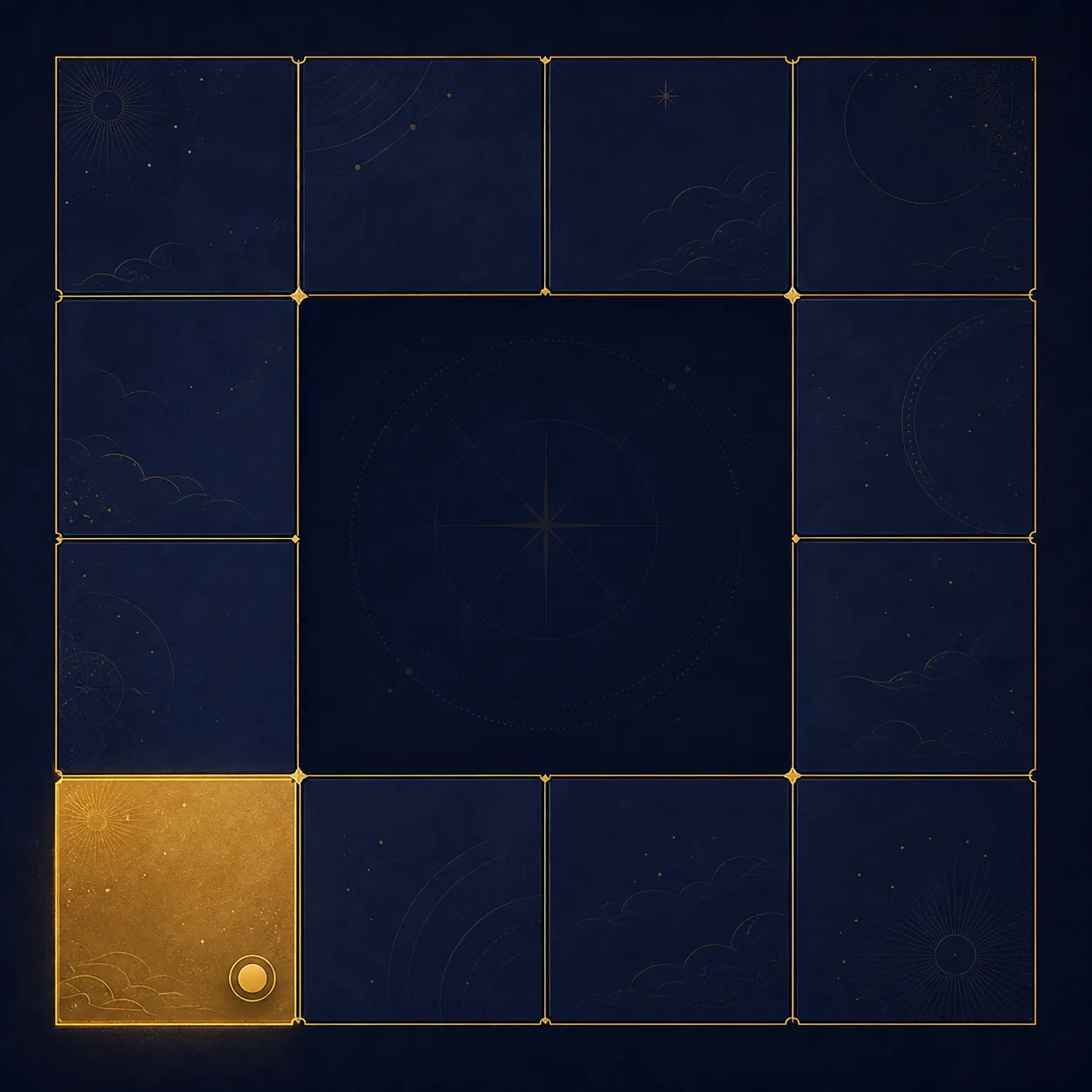
Find the Life Palace first
Locate the palace labeled Life Palace, often shown as 命宮 or Ming Gong. This is the first anchor for a beginner's reading. Note its position, the earthly branch attached to it, and the principal stars placed there. The purpose is not to force a personality verdict from one label. It is to establish the chart's central reference point before you inspect the surrounding domains.
The Life Palace gives the initial frame for questions about disposition, orientation, and the way the chart organizes the person being read. Interpretive traditions may use additional relationships and supporting palaces, but those relationships are difficult to evaluate if the anchor palace has not been identified correctly.
Use the other palaces as domains
After the Life Palace, move to the palaces that correspond to the question you actually have. The chart may include domains such as career, wealth, relationships, health, family, travel, property, friends, and siblings. Their value comes from their relationship to the whole chart, not from reading the palace title as a guaranteed outcome.
For example, a career question calls for attention to the Career Palace and its connection with the Life Palace, rather than a scan for a single star that supposedly guarantees success. A relationship question similarly needs the relevant relationship domain in context. The palace identifies where a theme is organized; it does not by itself determine what must happen.
This order also prevents the most common beginner error: jumping from an unfamiliar star name to a dramatic conclusion. First identify the domain, then see which stars and relationships modify it, and only then consider how the theme may be expressed.
Leave Four Transformations and luck cycles for later
Four Transformations and luck cycles add timing and movement to the chart, but they are poor starting points when the basic layout is still unfamiliar. Read them after you know the Life Palace and the domain palace relevant to your question. Otherwise, a prominent transformation or an active luck period can pull attention away from the structure it is meant to modify.
Luck cycles should also be treated as interpretive periods, not as guarantees that an event will occur. They can help organize when a theme receives more attention, but they do not remove the need to examine the underlying palace relationships or the person's actual circumstances.
A practical first reading therefore has a narrow scope: confirm the input, find the Life Palace, identify the domain connected to your question, and only then examine additional stars, Four Transformations, or luck cycles.