On August 26, 2026, National Dog Day again filled social feeds with adoption stories, working dogs in harnesses, and household companions waiting with complete attention for someone to come through the door. That makes the connection to the Chinese zodiac Dog feel almost immediate: both are associated with loyalty, protection, and service.
The resemblance is meaningful, but it is not evidence of a shared history. National Dog Day is a modern American observance, while the zodiac belongs to a much older Chinese system of animals, calendar cycles, directions, seasons, elements, and hours. Their meeting point is the guardian role humans have attached to dogs—and the responsibilities that role implies.
A modern observance rooted in one adoption
Pet lifestyle advocate Colleen Paige founded National Dog Day in 2004. She selected August 26 because it was the date on which her family adopted a Shetland Sheepdog when she was ten years old. The observance recognizes dogs of every breed and mixed ancestry, with particular attention to animals awaiting rescue and to dogs working in law enforcement, guidance, detection, and search and rescue.[1]

The childhood adoption story gives the day its proper scale. Rescue is not an abstract celebration of canine goodness. Someone brings an animal home, accepts the consequences of its earlier treatment, and does the repetitive work of feeding, training, veterinary care, and rebuilding trust. Working dogs make the same point from another direction: loyalty may be emotionally moving, but guiding, detecting, searching, and protecting are forms of labor.
That combination—affection joined to duty—is where National Dog Day and the Chinese zodiac Dog most convincingly overlap.
The Dog’s place in the zodiac is built around watchfulness
The Chinese zodiac is more than a sequence of twelve animal labels attached to birth years. Each animal corresponds to an Earthly Branch—one of twelve traditional signs used to organize recurring units of time and direction. Within this structure, the Dog is the eleventh animal and corresponds to the branch xu (戌). It is associated with Yang energy, the fixed element Earth, and autumn.[2][3]
| Zodiac position | Traditional correspondence | What it contributes to the symbolism |
|---|---|---|
| Eleventh animal | Dog | Its place in the twelve-animal cycle |
| Earthly Branch | xu (戌) | Connects the Dog to the wider calendar and timekeeping system |
| Polarity | Yang | An outward, active quality |
| Fixed element | Earth | Stability, groundedness, and holding one’s position |
| Season | Autumn | The year moving toward closure and storage |
| Double-hour | 19:00–20:59 | The traditional evening period associated with dogs guarding homes |
The double-hour is the most revealing correspondence. Traditional Chinese timekeeping divided the day into twelve periods, each approximately two modern hours long and associated with a zodiac animal. The Dog’s period runs from 19:00 to 20:59, after daylight has faded and households have settled for the evening. It is conventionally described as the time when dogs carry out their duty of guarding houses.[2][3]
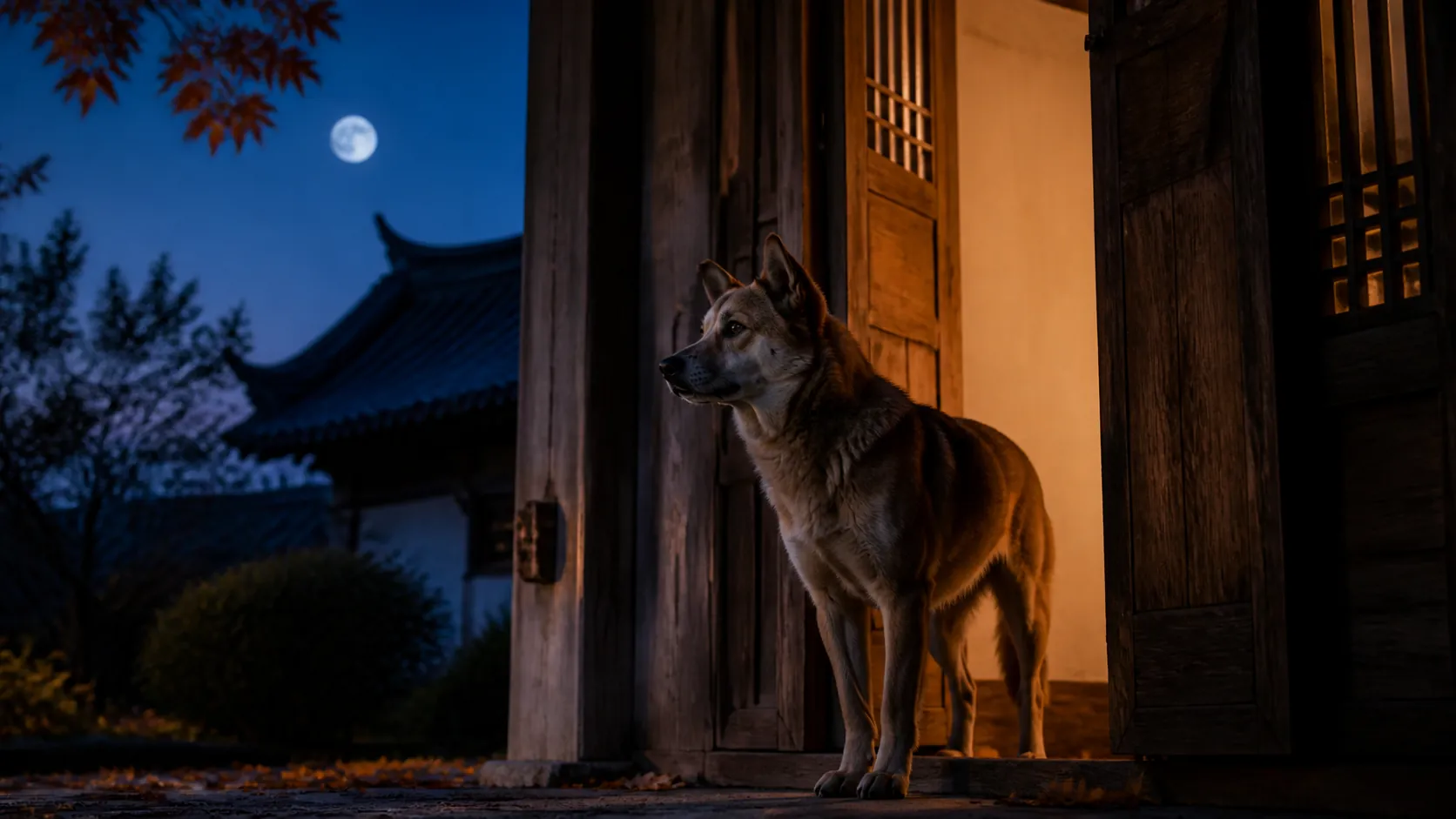
That detail does more than repeat a familiar claim that dogs are loyal. The animal is positioned at the threshold, during the hours when vigilance becomes useful. Earth adds the sense of standing firm; autumn places the sign in a season of gathering and safeguarding. These correspondences do not prove that everyone born in a Dog year will behave alike, but they show why protection is structurally present in the sign’s traditional meaning.
Popular descriptions consequently associate Dog people with fidelity, courage, honesty, watchfulness, protectiveness, and a strong sense of justice.[4][5][6] The less flattering traits are often the shadow of the same role. Someone perpetually scanning for danger may become anxious; someone expecting standards to be upheld may grow pessimistic when they are not. Folkloric personality language is most useful here as a portrait of the overburdened guardian, not as a diagnosis attached to a birth certificate.
A birth year needs a calendar check
Zodiac signs follow the Chinese calendar rather than changing automatically on January 1. Because the new zodiac year begins in January or February, someone born near the start of a Gregorian year may belong to the preceding animal sign.[2][3] A year alone is therefore insufficient for January and February birthdays; the exact date must be compared with that year’s lunar-calendar boundary.
This is the same calendar issue that matters in any careful single-sign zodiac explainer: establish the correct sign first, then discuss its cultural associations. Even after that check, the sign remains one traditional interpretive layer rather than a complete account of character.
Why did the Dog finish eleventh?
The Great Race, a popular story explaining the order of the zodiac animals, gives the guardian interpretation a useful complication. In a widely told version, the Dog is an excellent swimmer but reaches the finish only in eleventh place because it stops to bathe or play in the water.[2][4] Loyalty does not make this Dog flawless. It can still be distracted by pleasure and arrive late.
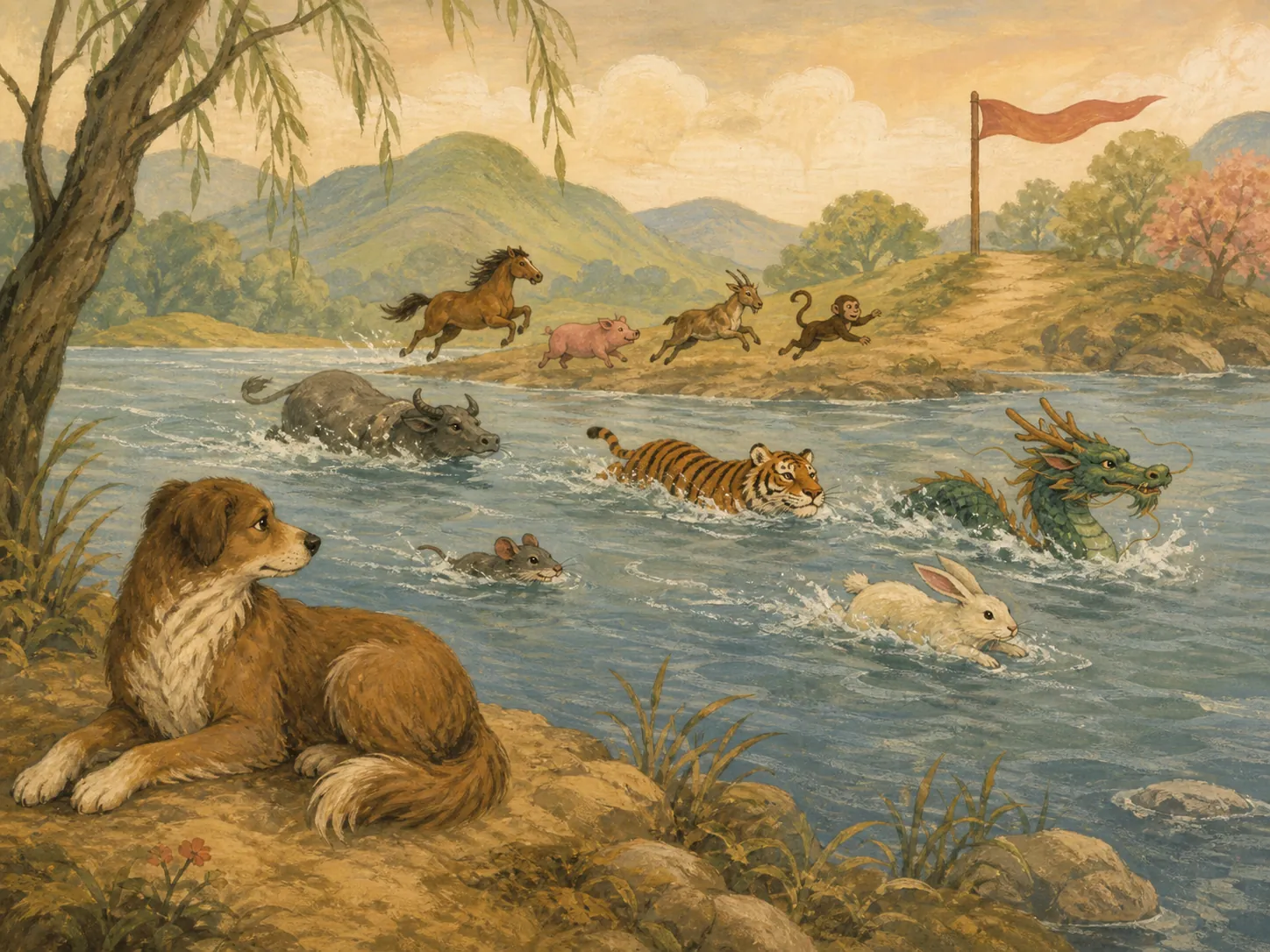
Another telling places the delay in a different light. In that version, the Dog remains behind to guard the riverbank while the other animals cross. It enters the race late because it has been attending to that responsibility, and its reliability earns it a place in the zodiac.[5]
These accounts should remain side by side. The guardian version fits the Dog’s protective symbolism beautifully, but it is one folkloric variant rather than a hidden correction to every other telling. The bathing version supplies something equally valuable: an imperfect animal whose recognized virtues do not erase appetite, delay, or error.
The contrast also clarifies what the zodiac stories do. They do not function as a single historical record with one authorized account of a literal race. Retelling gives communities room to emphasize different qualities. One Dog enjoys the river; another keeps watch over it. Both arrive eleventh, but only one turns lateness into evidence of duty.
Shared virtues without a shared origin
National Dog Day is not a Chinese zodiac ritual, and there is no need to invent a historical lineage between them. The modern observance began with an adoption anniversary and expanded around rescue, humane responsibility, and recognition of working dogs. The zodiac Dog belongs to a Chinese symbolic system in which its branch, Earth association, autumn season, and evening watch already position it as a steadfast guardian.
Traditional lists also associate the Dog with the lucky numbers 3, 4, and 9.[2][4] Such details can be enjoyable cultural color, but they say less about the sign than the image of a dog keeping watch from 19:00 to 20:59. Numbers are easy to print on a charm; guardianship asks who remains attentive when everyone else has gone indoors.
Zodiac compatibility readings deserve the same restraint. They can provide a vocabulary for discussing loyalty, conflict, or different expectations, as long as they remain interpretive rather than deterministic. That principle applies whether considering a Dog pairing or reading broader Chinese zodiac compatibility examples. No animal sign can decide whether someone will protect, abandon, trust, or care for another living being.
The connection ultimately rests on a modest but durable observation. National Dog Day gives modern Western form to virtues Chinese tradition has long attached to the Dog: loyalty expressed through protection, courage made visible through service, and affection proven by accepting responsibility. The symbolism matters most when it directs attention back to real dogs—the rescued animal learning that a door will open again, the guide dog navigating a crossing, or the search dog still working while others wait.
References
- National Dog Day. National Dog Day.
- Dog (zodiac). Wikipedia.
- Chinese zodiac. Wikipedia.
- Dog. ChineseNewYear.net.
- Chinese Zodiac Dog. Hey China.
- Year of the Dog. China Highlights.