No. Claudeforce should not be relied upon to calculate a BaZi chart from a birth date and time. It was introduced as an enterprise sales assistant, and the available product announcement does not establish that it contains a purpose-built Chinese-calendar engine. A fluent answer about Heavenly Stems, Earthly Branches, or the Four Pillars would therefore not prove that the underlying chart had been calculated correctly.
The safer division of labour is straightforward: use dedicated BaZi software to generate and preserve the chart, then give that completed chart to Claudeforce only if you want help explaining terminology or organising questions about it.

What Claudeforce is designed to do
The name can easily lead to the wrong assumption. “Claude” suggests a conversational AI that can discuss many subjects, while “force” connects the product to Salesforce. Neither part of the name indicates a BaZi calculation system.
Salesforce and Anthropic announced Claudeforce on August 26, 2026. The announcement describes a “Salesforce in Claude” plugin with 37 prebuilt sales skills, including meeting preparation, deal health, and pipeline review. It also says the AIforce harness is scheduled to enter open beta in September 2026; as of August 28, that beta is still forthcoming rather than generally available.[1]
Those concrete skills tell us more than broad claims about AI leadership. They concern sales records, meetings, deals, and pipeline work. That is a coherent enterprise use case, but it is unrelated to generating the Four Pillars from birth information.
| Task | What the announced product scope supports | Reliability judgment |
|---|---|---|
| Prepare for a sales meeting | Named among the prebuilt sales skills | Within the announced domain |
| Review deal health or a pipeline | Named among the prebuilt sales skills | Within the announced domain |
| Calculate a BaZi chart from birth details | No specialist Chinese-calendar capability identified | Do not treat as verified |
| Explain concepts from a supplied chart | Potentially suitable as a language task | Use with clear limits |
Why a convincing response is not a verified chart
BaZi calculation and BaZi explanation are different jobs. Calculation produces the chart that all later discussion depends on. Explanation begins only after that chart exists: it may describe the displayed pillars, clarify a term, compare interpretations, or turn technical language into a more readable account.
A broad conversational interface can blur this boundary because it presents both kinds of output in the same polished prose. If asked to “calculate and interpret my BaZi,” it may return a neat arrangement of pillars followed by a detailed reading. The interpretation can sound internally consistent even when the calculation source has never been established.
That is especially difficult for a beginner to detect. Someone who already knows what the pillars should be can compare the response with a trusted chart. Someone seeking a first chart has no such reference point and may mistake confidence, formatting, and correct terminology for calculation reliability.
The available Claudeforce announcement does not report a BaZi calculator, a specialist calendar component, or testing against verified Four Pillars outputs.[1] This does not prove that the interface could never produce a correct chart by chance or through some future integration. It means there is no basis here for treating chart generation as a demonstrated Claudeforce capability.
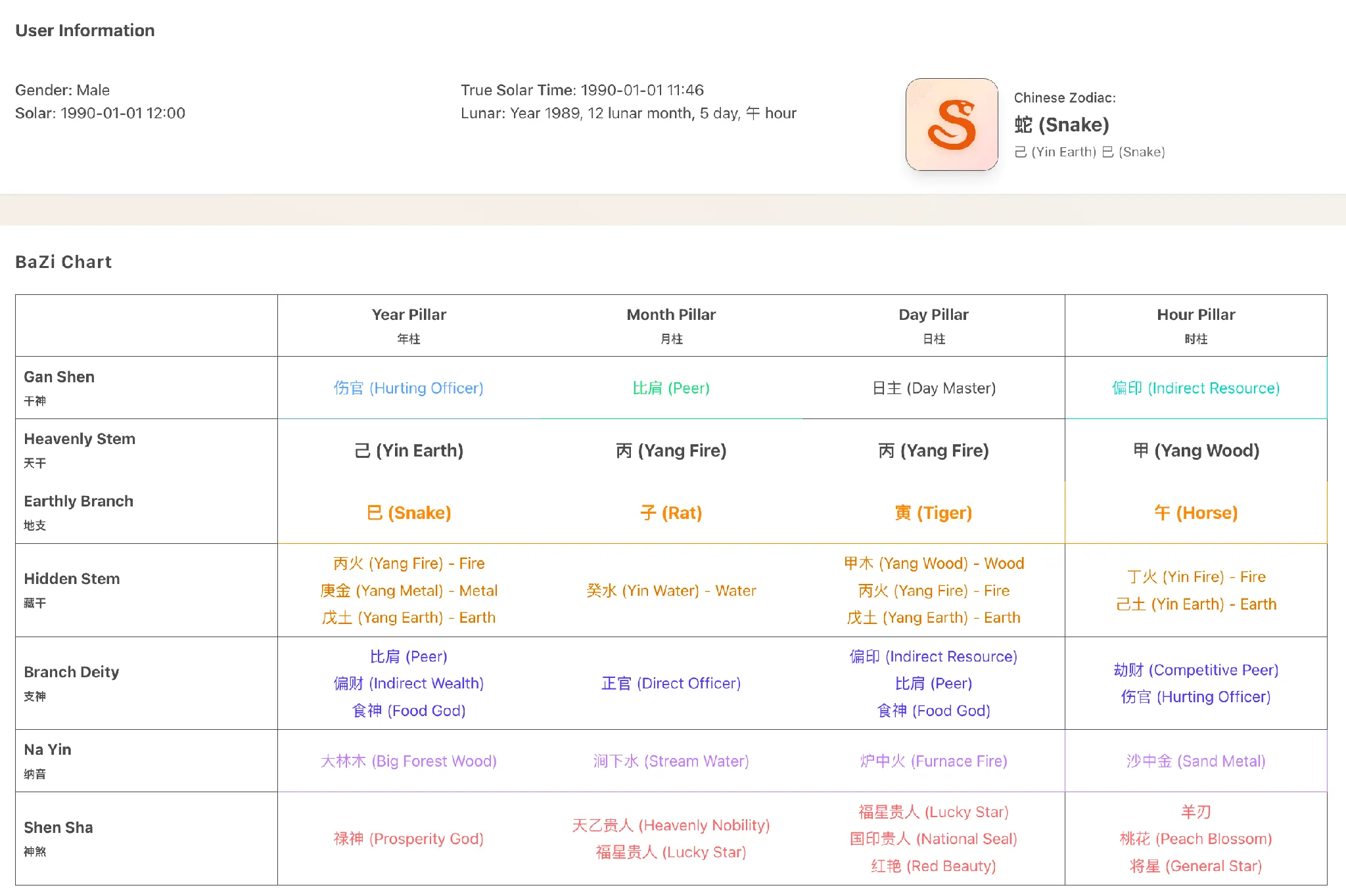
A safe workflow for using Claudeforce with BaZi
The practical solution is not to avoid language assistance altogether. It is to keep the authoritative calculation outside the conversation and make the handoff visible.

1. Generate the chart with dedicated BaZi software
Enter the birth information into a calculator built specifically to produce BaZi charts. Review the information you entered before accepting the result. The purpose-built calculator, rather than Claudeforce, should remain the source of the Four Pillars used throughout the rest of the session.
If important input information is uncertain, preserve that uncertainty instead of asking an explanatory assistant to resolve it silently. A polished interpretation cannot repair an unresolved calculation input.
2. Preserve the calculated result
Save the complete chart as text, an image, or an exported result. Keep the original birth information with it and record which calculator produced it. This gives you a stable calculation source rather than forcing the assistant to reconstruct the chart later.
Do not copy only the part of the chart that seems interesting. An incomplete excerpt can deprive the explanation of context, while retyping individual characters creates another opportunity for transcription errors.
3. Supply the chart and restrict the task to explanation
When using Claudeforce, state that the attached or pasted chart is the calculation source. Ask it to explain what is already present rather than recompute the pillars. A useful instruction could read:
This BaZi chart was generated by dedicated BaZi software. Treat the supplied Four Pillars as fixed and do not recalculate or replace them. Explain the displayed terms in plain English, identify where interpretations may differ, and say when the chart does not contain enough information to answer a question.That instruction establishes a clean boundary. The assistant may reorganise information, define vocabulary, or help formulate questions for further study. It is not being asked to certify the chart or imitate a calendar engine.
4. Check that the explanation has not altered the source
Compare every pillar mentioned in the response with the saved chart. If Claudeforce substitutes a character, invents a missing field, or claims that the chart should contain different pillars, stop using that response as an explanation. Return to the dedicated calculator for calculation questions.
This review is not a second BaZi calculation. It is a source-integrity check: did the assistant explain the material it received, or did it quietly create new chart data?
What Claudeforce can safely help with
Once a verified chart has been supplied, limited language tasks remain reasonable. Claudeforce may help make dense material easier to navigate, provided its output is treated as an explanation rather than an independent calculation.
- Explain terminology that appears in the supplied chart.
- Restate a technical passage in clearer language.
- Organise observations under the four supplied pillars without changing them.
- Identify assumptions or unclear terms in an existing interpretation.
- Prepare questions to take back to a dedicated BaZi tool or a knowledgeable practitioner.
Even within this narrower role, fluent wording should not be confused with authoritative interpretation. Asking the assistant to label uncertainty and avoid introducing chart information that was not supplied makes its contribution easier to inspect.
The reliability boundary
Claudeforce may be useful within the sales workflows for which it was announced, and its conversational abilities may also make supplied BaZi material easier to read. Neither point establishes reliable Four Pillars calculation.
For a dependable workflow, let dedicated BaZi software supply the chart and preserve that output as the calculation source. Claudeforce can then assist with explanations, as long as it is explicitly told not to recalculate or modify the Four Pillars.
References
- Salesforce and Anthropic Announce Claudeforce: The #1 AI Meets the #1 AI CRM, Salesforce, August 26, 2026.