The Farmers’ Almanac Canada winter forecast for 2026–27 and China’s 24 solar terms appear to meet around December 21–22, when the December solstice marks astronomical winter and Dongzhi marks the sun’s seasonal turning point. The resemblance is real, but limited: one is a long-range weather outlook, while the other is a fixed astronomical calendar.
Even the apparent agreement on the solstice requires care. The Farmers’ Almanac gives the 2026 solstice instant as December 21 at 15:50 UTC, whereas timeanddate lists it as December 21 at 20:50 UTC.[1][2] Those times cannot be silently treated as equivalent. The latter converts to December 22 in China Standard Time, consistent with Chinese calendars that place Dongzhi on December 22, while the former would still fall late on December 21 in China. The sources therefore disagree on the instant, and the calendar date changes with the timezone.
| Question | Chinese 24 solar terms | Farmers’ Almanac outlook |
|---|---|---|
| What is its main job? | Divide the sun’s annual apparent motion into fixed calendar markers | Describe probable weather patterns over a coming season |
| What does a date mean? | The sun has reached a specified ecliptic longitude | The outlook applies broadly to a stated period or region |
| Does it predict local snow or temperature? | No | It offers broad predictions, not local guarantees |
| How should Canadians use it? | To locate traditional seasonal rhythm and observances | As one general long-range outlook among other weather information |
The six winter solar terms in 2026–27
Using China Standard Time as the reference, the winter sequence begins before the December solstice and continues into late January. Published lists may differ by one calendar day because a solar term begins at an astronomical instant, not at midnight everywhere.[3][4]
| Solar term | Common English rendering | 2026–27 date in China Standard Time | Calendar meaning |
|---|---|---|---|
| Lidong (立冬) | Beginning of Winter | November 7, 2026 | Opening of winter in the traditional seasonal calendar |
| Xiaoxue (小雪) | Minor Snow | November 22, 2026 | A weather-inflected seasonal name, not a snowfall forecast |
| Daxue (大雪) | Major Snow | December 7, 2026 | A later point in the traditional winter sequence |
| Dongzhi (冬至) | Winter Solstice | December 22, 2026 | The sun reaches its solstitial position |
| Xiaohan (小寒) | Minor Cold | January 5, 2027 | The first of two post-solstice cold terms |
| Dahan (大寒) | Major Cold | January 20, 2027 | The final solar term before the spring sequence |
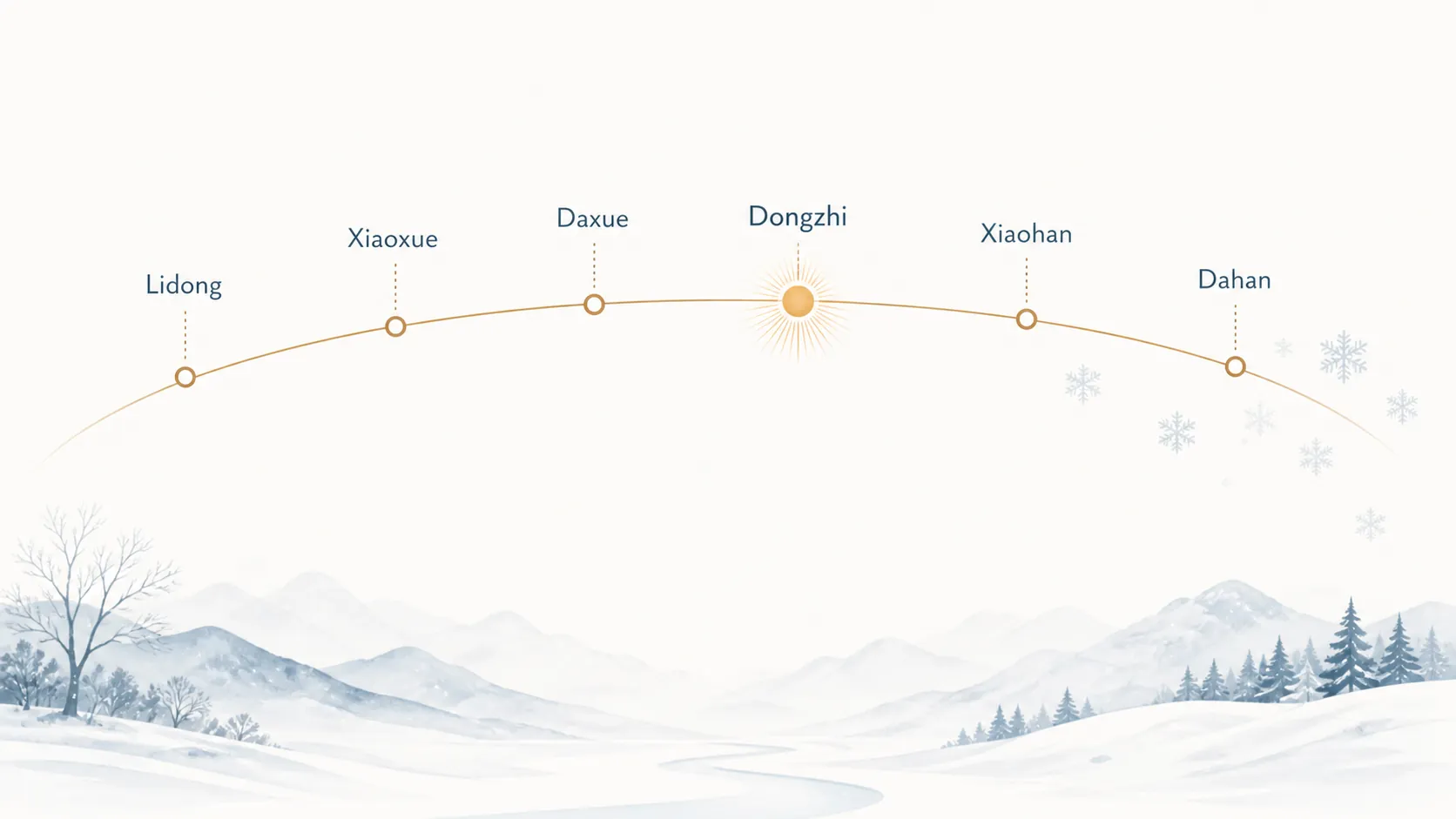
These dates are calculated from the sun’s apparent position. The full system divides the ecliptic into 24 sections of 15 degrees each, producing evenly spaced astronomical markers across the year.[5] A term such as Daxue therefore arrives because the sun has reached the relevant longitude—not because heavy snow has begun in Toronto, Calgary or Halifax.
The weather-coloured names developed from observations associated with the Yellow River basin and the seasonal life of North China. They carry agricultural and cultural meaning, but their literal conditions cannot be exported to every climate. UNESCO inscribed the knowledge and practices surrounding the 24 solar terms on the Representative List of the Intangible Cultural Heritage of Humanity in 2016.[6] That recognition speaks to cultural significance and continuity, not verified Canadian forecasting skill.
What the Farmers’ Almanac forecasts for Canada
The Farmers’ Almanac labels its 2026–27 Canadian outlook “Snow, Sleet, and Surprises!” Its central theme is a changeable winter marked by sharp temperature swings and an active storm track, rather than one uniform pattern holding from November through March.[7] That is a broad seasonal proposition: it does not establish which community will receive a particular storm or how much snow will fall on a given date.
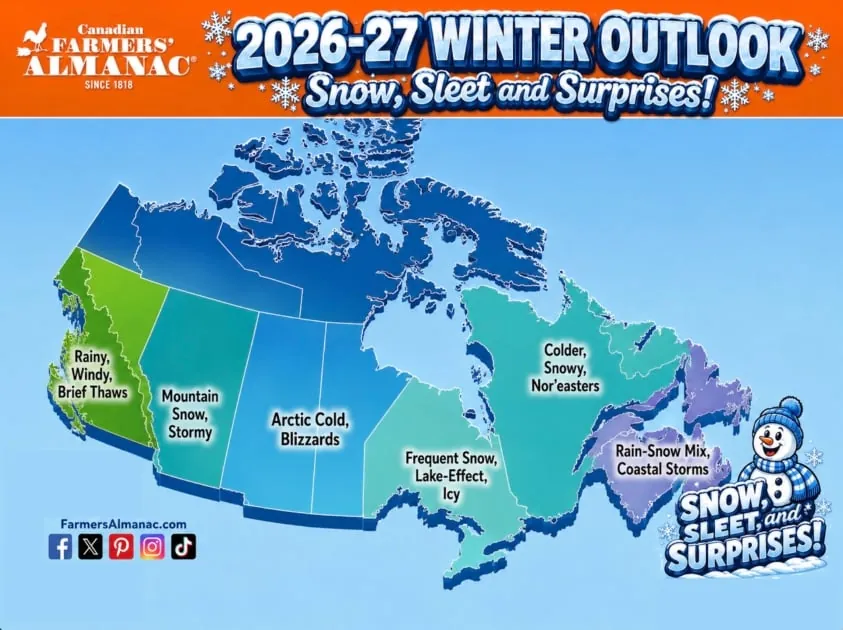
- Prairies: the outlook emphasizes intrusions of Arctic cold and the possibility of blizzards.[7]
- Ontario: lake-effect snow and episodes of ice receive particular attention.[7]
- Quebec and Labrador: the forecast leans colder and snowier, with nor’easter threats included in the regional description.[7]
- Atlantic Canada and the North: the publication provides separate regional notes, but these remain large-area outlooks rather than predictions for individual communities.[7]
Regional wording matters. “Ontario” spans several weather regimes, and a forecast of lake-effect snow is much more relevant near susceptible lakes and prevailing snowbelts than it is to every location in the province. Likewise, a Prairies blizzard signal describes a seasonal risk; it does not tell a traveller that a particular highway will close on a particular weekend.
Two almanacs, two separate forecasts
The Canadian regional forecast discussed here comes from the Farmers’ Almanac, founded in 1818 and published at farmersalmanac.com. It is not the Old Farmer’s Almanac, founded in 1792 and published at almanac.com. The latter’s detailed 2026–27 Canadian material is gated in its 2027 edition, so its predictions should not be filled in with language borrowed from the Farmers’ Almanac.
The distinction also applies to methodology. The Old Farmer’s Almanac describes its own proprietary approach as combining solar science, climatology and meteorology, including attention to sunspot activity and other factors.[8] That description belongs to the Old Farmer’s Almanac. It should not be transferred automatically to the separate publication responsible for the Canada forecast above.
Where El Niño enters the outlook
NOAA’s August 13, 2026 El Niño Advisory gave a greater than 90% chance of a very strong event during fall and winter 2026–27.[9] NOAA is the scientific authority for ENSO status; the Farmers’ Almanac applies that large-scale context within its own outlook.
Even a strong ENSO signal would not dictate one result across Canada. Large-scale ocean and atmosphere conditions can alter the odds of certain patterns, but local weather still depends on storm tracks, circulation and geography. A probability assigned to an El Niño category is not a probability that a named Canadian city will have a snowy winter.
Why the solstice creates only a loose agreement
Both systems refer to the sun, but the sun performs different work in each. In the solar-term calendar, its ecliptic longitude defines the marker itself. In a weather outlook, solar factors—where used—are inputs considered alongside assumptions about atmospheric or oceanic behaviour. Sharing an astronomical reference does not make the outputs interchangeable.
Dongzhi nevertheless captures a familiar seasonal intuition: the shortest day is not normally the end of winter’s deepening cold. Xiaohan and Dahan follow the solstice on January 5 and January 20, while Western lore expresses a similar pattern in the line, “As the days lengthen, so the cold strengthens.”[1] This is consistent with seasonal lag—the land, water and atmosphere do not reach their coldest state at the instant of minimum daylight.
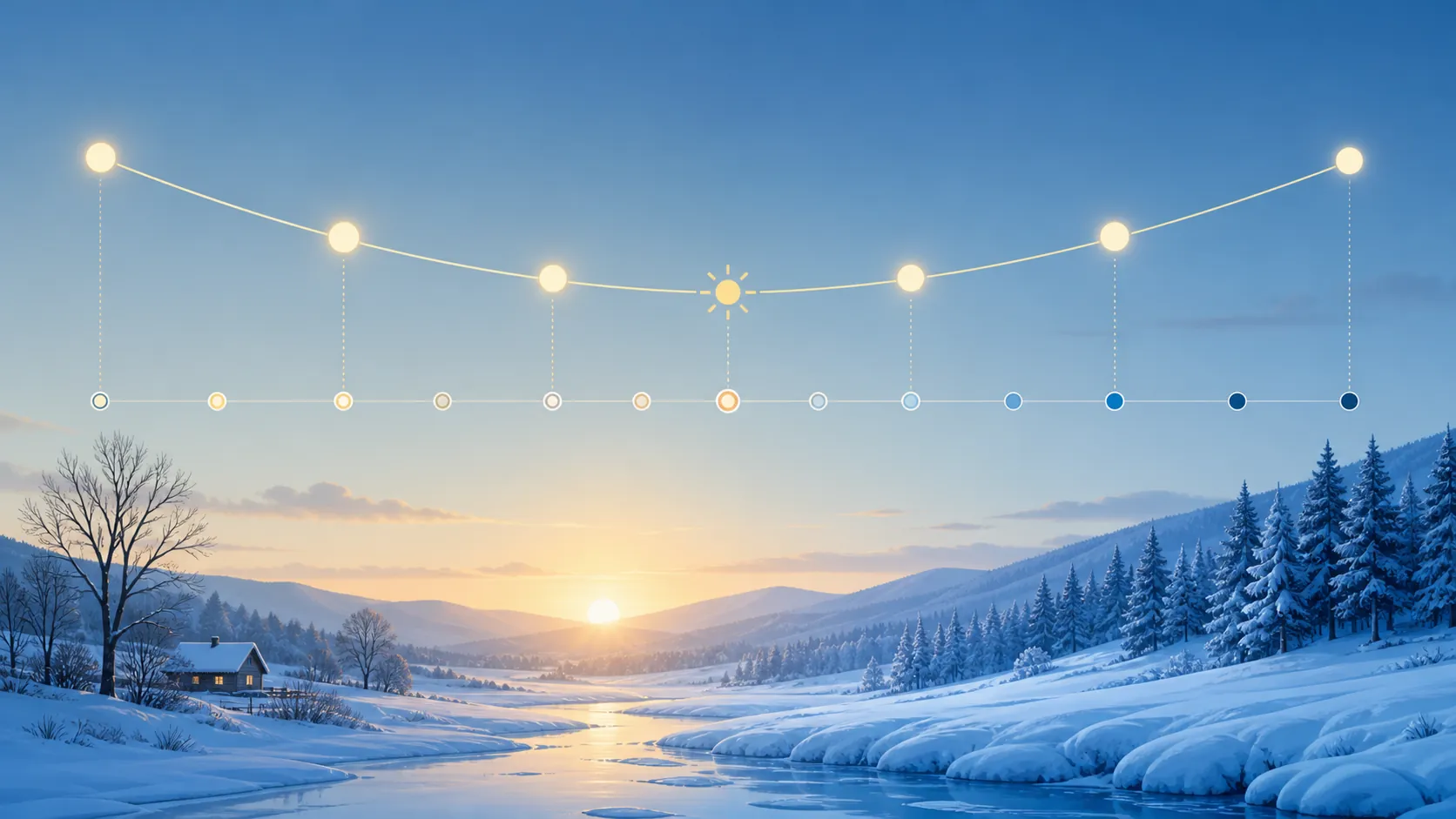
That shared rhythm is useful for interpretation, but it is not evidence that Chinese solar terms and a North American almanac independently predicted the same winter. Seasonal lag explains why cold often intensifies after the solstice in many northern climates. It does not establish the severity, duration or snowfall total of Canada’s 2026–27 season.
How much confidence should the forecast receive?
Accuracy claims need their publication names attached. The Farmers’ Almanac claims an accuracy rate of 80–85%, while the Old Farmer’s Almanac separately reports an average of 80% for its own forecasts.[8][10] These are self-reported figures, not independent findings that the two publications share one verified level of skill.
Climavision cites a University of Illinois assessment that placed almanac accuracy at about 52%, close to chance for the forecast categories examined.[10] That figure should also be kept within the limits of the cited study rather than treated as a universal score for every region, lead time and forecast format.
A University of Georgia Extension comparison for a specified recent Southeast winter found NOAA’s Climate Prediction Center outlook performed better than forecasts from the two almanacs.[11] It was a particular regional and seasonal comparison, not proof that every government outlook will outperform every almanac statement in all circumstances. It does, however, support giving more weight to transparent, regularly updated meteorological guidance.
SnowBrains raises a different credibility problem: much of the 2026–27 Canadian wording is broad enough to fit conditions experienced in many ordinary winters across the provinces concerned.[12] Phrases such as “sharp swings,” “active storms” and “Arctic cold” may sound vivid while leaving considerable room for a forecast to appear successful after the fact.
For practical Canadian planning, the six solar terms can locate winter within a traditional astronomical and cultural calendar. The Farmers’ Almanac can be read as a broad, probabilistic seasonal outlook, especially for the regional hazards it chooses to emphasize. Neither can promise when a driveway will need clearing, whether a trip will meet freezing rain, or how severe the winter will be at one address.
References
- Winter Solstice 2026: When Is the First Day of Winter? — Farmers’ Almanac.
- December Solstice 2026 — timeanddate.com.
- 24 Solar Terms in China — China Educational Tours.
- The 24 Solar Terms — China Highlights.
- Solar term — Wikipedia.
- The Twenty-Four Solar Terms, knowledge in China of time and practices developed through observation of the sun’s annual motion — UNESCO, 2016.
- 2026–2027 Winter Weather Forecast for Canada — Farmers’ Almanac, updated August 21, 2026.
- How The Old Farmer’s Almanac Predicts the Weather — The Old Farmer’s Almanac.
- El Niño/Southern Oscillation (ENSO) Diagnostic Discussion — NOAA Climate Prediction Center, August 13, 2026.
- Weather Forecasting and the Farmers’ Almanac — Climavision.
- Winter weather showdown: Farmers’ Almanac vs. meteorologists — University of Georgia Extension, March 2024.
- Farmers’ Almanac Drops 2026–27 Canada Winter Forecast — SnowBrains.