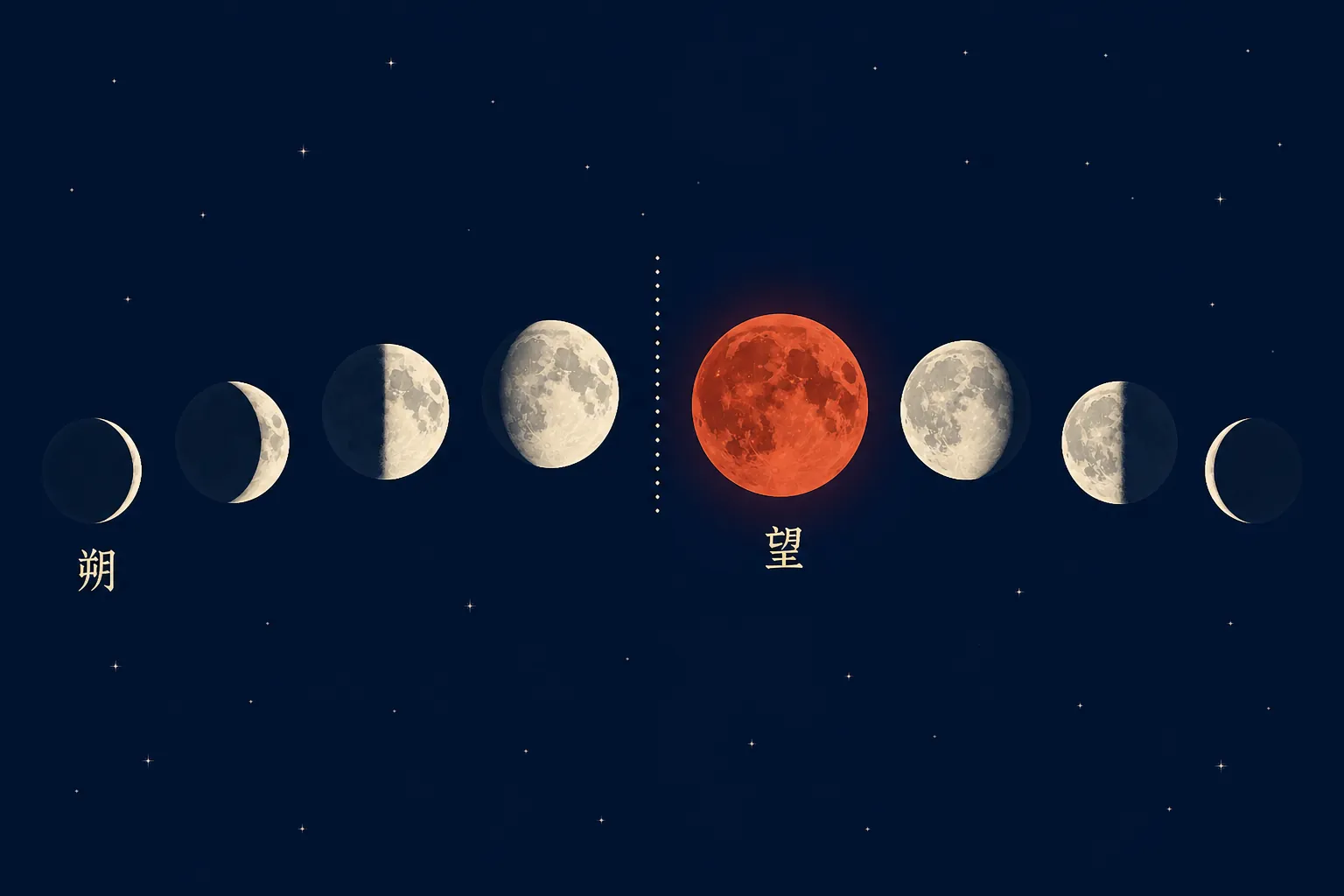
In the Chinese lunisolar calendar, the route to a red eclipsed Moon begins at 朔 (shuò), the astronomical new moon that opens the lunar month. The Moon then waxes toward 望 (wàng), the full-moon point usually falling around the fifteenth or sixteenth day. A lunar eclipse is possible only at full moon, so every lunar eclipse belongs to this mid-month position in the calendar—even though most full moons pass without an eclipse.[1][2]
| Calendar position | Moon phase | What it means for an eclipse |
|---|---|---|
| 朔 (shuò) | New moon and beginning of the lunar month | A lunar eclipse cannot occur |
| Waxing days | The illuminated portion grows | The Moon is moving toward the required full-moon alignment |
| 望 (wàng), near day 15–16 | Full moon | A lunar eclipse is possible if the Sun, Earth and Moon align closely enough |
This calendar fact answers when the phenomenon can appear. Its color requires a second explanation: during a lunar eclipse, Earth stands between the Sun and the full Moon, placing part or all of the Moon in Earth’s shadow. Yet that shadow is not perfectly black because some sunlight passes through the rim of Earth’s atmosphere and is redirected toward the Moon.
Why the eclipsed Moon looks red
As sunlight travels through Earth’s atmosphere, Rayleigh scattering disperses shorter blue wavelengths more strongly than longer red and orange wavelengths. The light that continues through the atmosphere and reaches the eclipsed Moon is therefore weighted toward the red end of the spectrum. The Moon reflects that filtered light back to observers on Earth. It is the same broad atmospheric effect that gives sunsets their reddish color.[2][3]
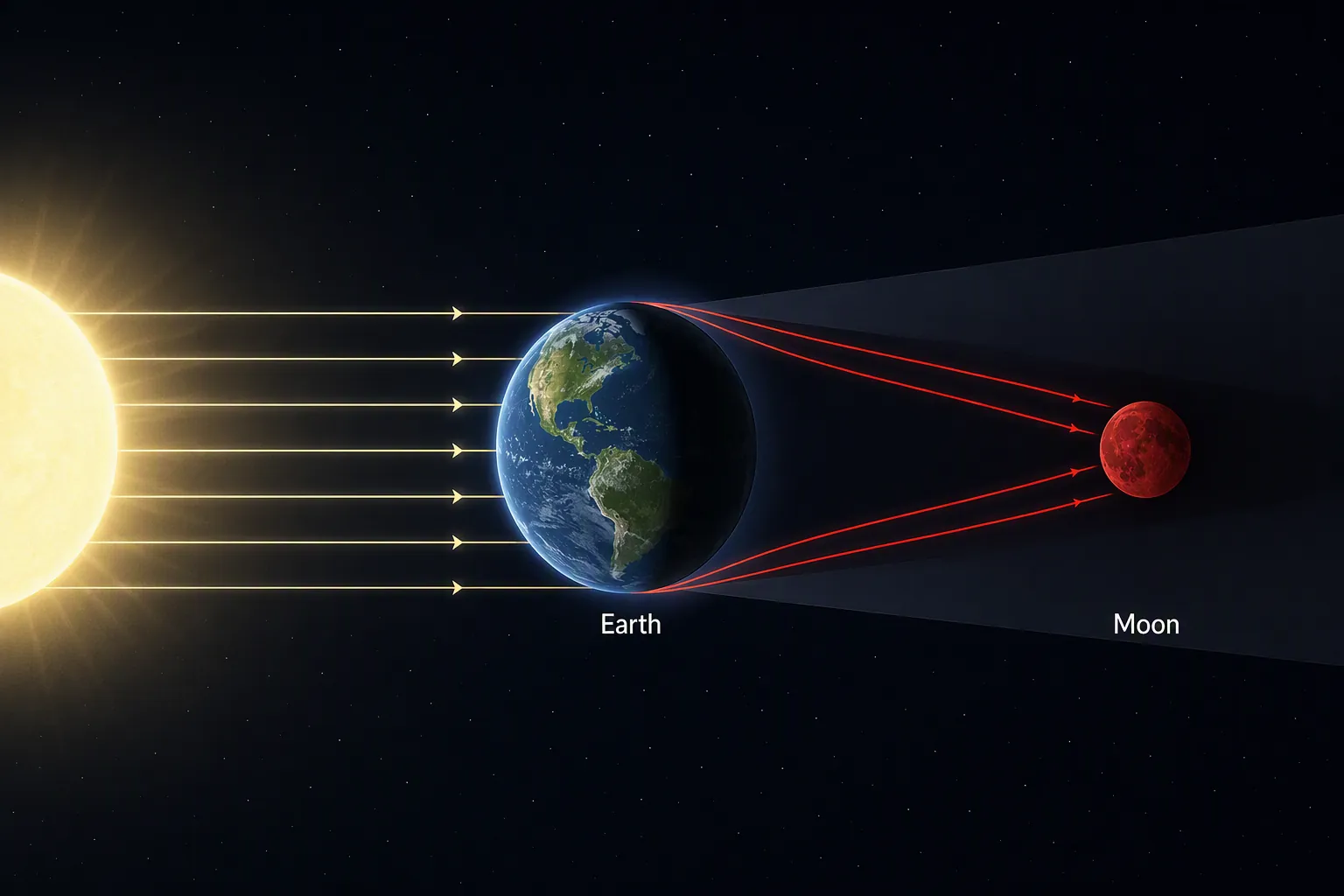
The depth of the color can vary. Atmospheric conditions and the Moon’s path through Earth’s shadow can produce anything from a muted copper tone to a much darker red. “Blood moon” is a vivid modern description, but the color does not require a separate astronomical category or a supernatural cause.
Nor does every 望 produce an eclipse. The Moon’s orbit is tilted relative to Earth’s path around the Sun, so at most full moons the Moon passes above or below the darkest part of Earth’s shadow. The full-moon phase is necessary; sufficiently close alignment is the additional condition.[2]
The event of August 27–28, 2026 offers a timely example of why labels matter. It is a near-total partial lunar eclipse of about 96%, not a total eclipse. It still occurs at the full-moon point of the lunar month, but a small portion of the Moon remains outside Earth’s full shadow.[4]
Chinese observers recorded the sky and responded to it
China’s historical response to eclipses cannot be reduced to a contest between myth and science. Observation, prediction, ritual duty and moral interpretation could operate together. Court astronomers had practical reasons to watch the Moon closely: an eclipse was a public event, a calendrical event and a matter of state concern.
Even the date of the earliest surviving Chinese lunar-eclipse record should be presented with care. One account identifies an oracle-bone inscription from 1136 BCE, while a NASA Goddard history places the earliest record at about 1065 BCE. The latter source counts 545 Chinese eclipse records before 1500 CE, including 78 total eclipses.[5][6] These are competing source attributions, not figures that can be made consistent simply by choosing the earlier date.
Long sequences of observations allowed astronomers to recognize recurrence and improve forecasting. Prediction did not automatically abolish ritual. Knowing that an eclipse was due made it possible for the court to prepare its official response rather than wait for an inexplicable interruption in the sky.
Rescuing the Moon was an official procedure
An overview of Chinese eclipse traditions cites the Rites of Zhou in connection with an imperial drum proclamation intended to rescue the Moon. Much later, Qing ritual regulations assigned officials formal roles and prescribed plain clothing during the rescue observance.[5] The continuity lies less in an unchanged ceremony than in the idea that an eclipse demanded an organized public response.
The astronomer who anticipated the eclipse and the official who took part in the rite were therefore not necessarily expressing rival explanations. One dealt with celestial timing; the other fulfilled political and ritual obligations. Beating a drum did not alter Earth’s shadow, but performing the rite showed that the court had noticed the disturbance and was responding in the expected manner.
An eclipse could also examine the ruler
Under the broad framework often called 天人感应 (tiānrén gǎnyìng), events in Heaven could be read as responses to human government. An eclipse might therefore prompt scrutiny of the ruler’s conduct rather than merely fear about the Moon itself. A well-known court example concerns a solar, rather than lunar, eclipse: after an eclipse in 178 BCE, Emperor Wen of Han issued a public self-criticism and invited officials to identify his faults.[7]
That example should not be turned into a claim that every eclipse produced identical reforms. It shows how eclipse interpretation could direct responsibility upward. The striking event in the sky became an occasion for the sovereign to examine governance, while astronomical officers continued their separate work of observation and calculation.
Gongs, pots and the stories of a devourer
Outside formal court procedure, people made noise with drums, gongs and household pots; later accounts also include firecrackers. The action was commonly understood as driving away a being that was swallowing the Moon.[8][9] It made a frightening visual change answerable through coordinated sound: families and neighbors did something together while waiting for the Moon to return.
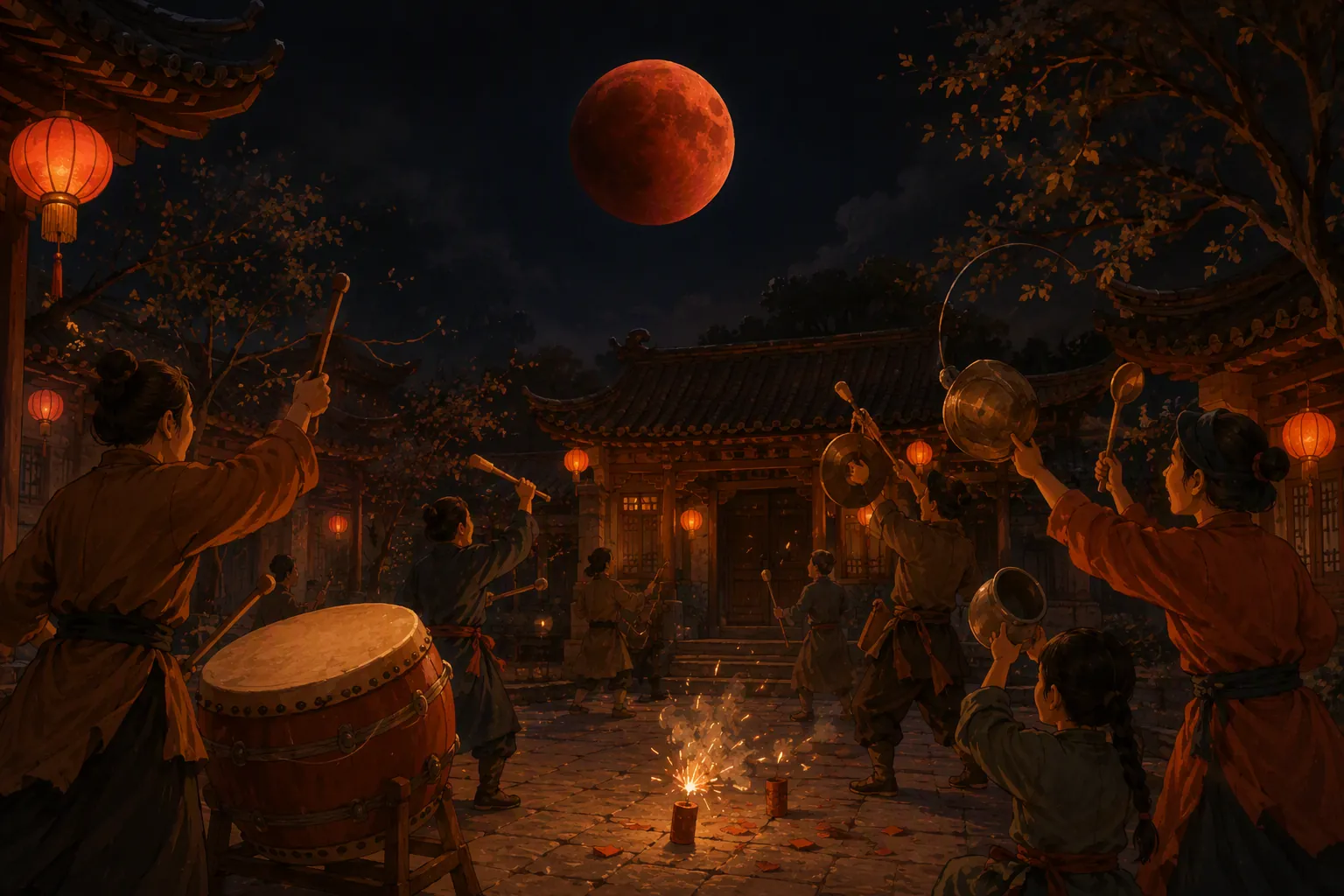
There was no single canonical Chinese devourer story. A heavenly dog, a dragon and a three-legged toad appear as coexisting variants in accounts of eclipse mythology.[8][9] Calling all of them “the Chinese explanation” would flatten traditions that circulated in different texts, regions and settings.
The household clamor also should not be treated as a smaller copy of the imperial rite. The court worked through offices, prescribed dress, proclamations and political responsibility. Folk action drew on local stories and accessible objects. Both answered the temporary disappearance of familiar moonlight, but they occupied different social worlds.
Does a lunar eclipse make the date inauspicious?
For date selection, the defensible conclusion is narrow. If a schedule is flexible, the visible eclipse hours can be treated as an observe-and-pause window: avoid beginning an important ceremonial act at the height of the eclipse, leave room to watch what is happening, and resume afterward. This is a practical contemporary interpretation of the historical response pattern, not a universal rule quoted from a classical almanac.
An eclipse does not establish that the entire 望 day is ruined. The astronomical event occupies a limited interval, while 望 identifies the full-moon position in the month. Condemning every hour of the day would confuse a phase marker with the duration of the eclipse.
| Scheduling question | Measured response |
|---|---|
| Can the activity move easily? | Consider pausing or avoiding the locally visible eclipse interval. |
| Must the activity happen that day? | Assess its real operational constraints rather than rejecting the entire 望 day. |
| Is the eclipse visible at the location? | Use local astronomical timing; an eclipse is not observed everywhere in the same way. |
| Will choosing another hour guarantee success? | No. Moving the time changes the schedule, not every factor affecting the outcome. |
The same restraint is useful when applying an almanac to modern events. The Falcon 9 launch-date case study likewise treats calendar indications as context for a real scheduling decision, not as a mechanism that overrides engineering, weather or human judgment.
At mid-month, the sequence remains orderly: 朔 begins the month, the Moon waxes, and 望 brings the full Moon. When the alignment is close enough, Earth’s shadow crosses it and atmospheric light colors it red. Chinese tradition gave that predictable interval several disciplined forms of attention—astronomical recording, court ritual, moral reflection and communal noise—without making the red Moon proof that every plan beneath it must fail.
References
- Calendar, chronology and astronomy — ChinaKnowledge
- Eclipses and the Moon — NASA Science
- Why Is the Moon Red During a Lunar Eclipse? — Time and Date
- Lunar eclipse guide: What they are, when to see them and where — Natural History Museum
- Lunar eclipse — Baidu Baike
- Sun-Earth Day 2009: Ancient Eclipses in China — NASA Goddard Space Flight Center
- A brief history of the solar eclipse — The World of Chinese, 2017
- Lunar eclipse — Wikipedia
- Tiangou — Wikipedia