Gilderoy Lockhart does not merely enter a room; he arranges the room around the fact that he has entered it. His public identity is reinforced by a hologram of his own face, a five-time Witch Weekly Most Charming Smile Award, an Order of Merlin Third Class and honorary membership in the Dark Force Defence League. He reportedly sends himself 800 valentines, producing both the admiration and the spectacle required to display it.[1]

That combination of warmth, theatricality and dependence on recognition makes Fire the most persuasive answer to a Gilderoy Lockhart Five Elements personality analysis. It is also where the analysis can go wrong. Calling him a “Fire type” should not become a diagnosis, a prediction of fate or a mystical excuse for his choices. No canonical source assigns him a wuxing element, and no single practitioner account establishes a universal Fire personality. This is an interpretive synthesis: a way to test whether the imagery and relationships of the Five Elements illuminate how his character works.
The useful question, then, is not whether every detail in Lockhart’s biography can be forced into a Fire checklist. It is why his social brightness proves so effective in public, yet so unstable when admiration, borrowed achievement and control of the story are removed.
What Fire explains about Lockhart
Modern practitioner descriptions of Five Elements personalities vary, so their trait lists should not be blended into one allegedly authoritative profile. One account from The Point associates Fire with being lively, charismatic, optimistic, enthusiastic, creative and alert.[2] Those qualities describe the Lockhart whom strangers can plausibly believe: animated, confident and able to turn a conversation, classroom or book launch into a performance.
Tao of Wellness gives Fire a more revealing social dynamic: it “attracts the most attention and also needs the most attention.” The same account warns that Fire’s power can invite arrogance or hubris and can become self-destructive.[3] This does not mean that confidence or charisma is secretly pathological. It means that the source of Lockhart’s magnetism and the source of his instability are closely connected. Attention is not simply something he enjoys after succeeding; it is part of the structure that lets him continue presenting himself as successful.
A description published by the International College of Oriental Medicine sharpens that dependence. It characterises Fire personalities as unable to sustain their interest and excitement without external props and other people’s attention: “by themselves they feel lifeless; in company they come alive.”[4] Lockhart’s props are unusually literal. Portraits, credentials, prizes, fan mail and published adventures all return his preferred image to him through other people’s eyes.

The 800 valentines are therefore more than a joke about vanity. They expose a closed circuit. Lockhart manufactures evidence of affection, places that evidence in public view and then uses the resulting commotion as proof that affection already exists. The audience sees popularity; he receives the stimulation of being treated as popular. His holographic self-image performs a similar trick, converting a book cover into a miniature stage on which he can remain visibly alive even while absent.
Awards and memberships serve a slightly different purpose. They give the performance a hard edge of authority. The Most Charming Smile Award confirms the very quality Lockhart already advertises, while the Order of Merlin and honorary league membership appear to certify achievement. None of these details alone makes Fire the only possible reading. Together, however, they reveal a personality organised around radiance, circulation and public response.
The substance missing beneath the spectacle
Lockhart’s problem is not that performance is inherently false. Teaching, writing and public life all involve presentation. The deeper failure is that he allows the visible result to replace the underlying capacity. Wizarding World’s account of his method describes a “work smarter, not harder” strategy centred on one genuine strength: Memory Charms. He takes other people’s accomplishments, alters their memories and presents their experiences as his own; as he concentrates on that single technique, his other magical abilities waste away.[5]
This is Fire in excess more convincingly than his taste for applause. A healthy public presence can be supported by practice, responsibility and competence that remain when nobody is watching. Lockhart reverses that relationship. The displayed achievement comes first, while the skill needed to survive the situations described in his books becomes unnecessary—or so he believes. If reputation can be secured by controlling memory, durable ability looks inefficient.
His optimism consequently becomes hubris. Confidence lets a capable person act despite uncertainty; Lockhart’s confidence allows him to ignore the difference between having narrated an adventure and being able to meet danger. He expects the social version of himself to keep working even where charm has no leverage. The people around him bear the consequences: students receive instruction from someone unable to perform the expertise he advertises, while the people whose deeds he appropriates lose control of their own stories.
That distinction matters because an elemental label can otherwise soften moral responsibility. Fire does not make Lockhart steal achievements or erase witnesses’ memories. His choices do that. Wuxing offers a vocabulary for the pattern of excess—expansion without support, visibility without substance and confidence without restraint—not a cause that absolves him.
When the instrument of control turns back on him
The Memory Charm is more than Lockhart’s preferred spell. It is the mechanism that keeps his identity intact. He cannot make the stolen adventures true, but he can try to remove the people capable of contradicting him. His reputation depends on public memory, while his method depends on selective erasure. He preserves the admired version of himself by subtracting other minds from the record.
On 29 May 1993, that method reverses. Lockhart attempts another Memory Charm with a damaged wand, the spell backfires and his own memories are erased. He later becomes a permanent patient in St Mungo’s Janus Thickey Ward, where his dictation includes the bleakly comic title “Who Am I?”[1] The celebrity who built himself from remembered achievements can no longer remember the self those achievements were supposed to prove.
Only now does the Five Elements controlling cycle become especially useful. Wuxing is better understood as a system of interacting phases or processes than as a row of isolated personality boxes. In its controlling cycle, Water restrains or extinguishes Fire.[6][7] The relationship is not a claim that every fictional water image must defeat every fiery character. Here it works as a compact metaphor: the power of erasure Lockhart repeatedly uses to protect his social flame finally extinguishes the identity it was meant to preserve.
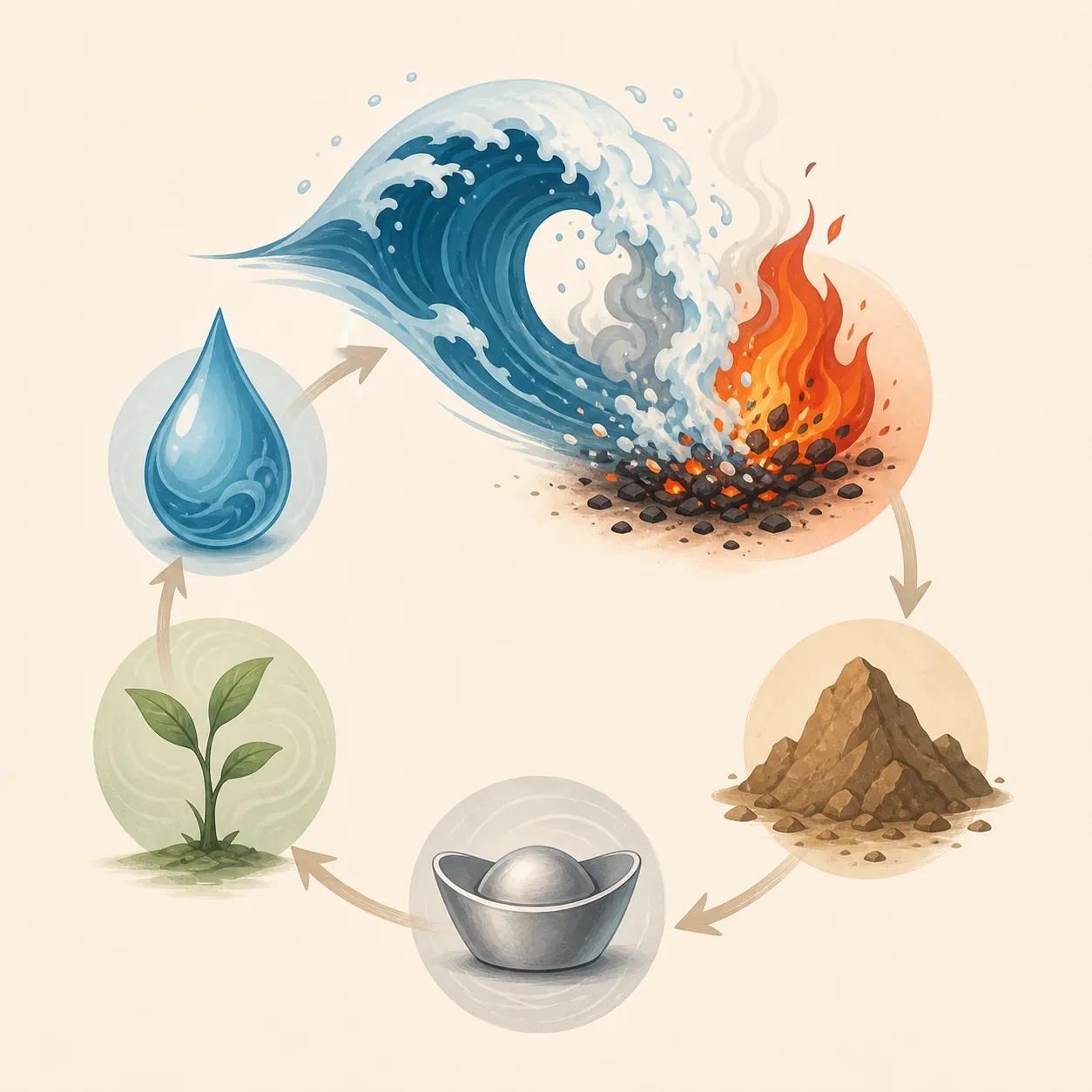
Water, in this reading, is not simply the backfired spell. It is the principle of cancellation already hidden inside Lockhart’s strategy. Every erased witness makes his fame safer, but also makes his identity more dependent on a manufactured record. Every stolen deed increases the splendour of the public persona, but widens the gap between that persona and the abilities available in a crisis. The strategy grows by consuming the conditions that could have given it substance.
His fate at St Mungo’s is poignant because some residual impulse toward celebrity survives even when the coherent biography does not. Yet the analysis should stop short of saying that Water metaphysically caused his downfall or that wuxing predicted the plot. The cycle supplies an interpretive shape after the fact. It shows why the ending feels more exact than a generic punishment: a man who treated memory as editable publicity loses the memory needed to maintain his own performance.
Why Fire is persuasive without being definitive
Other elemental emphases can be argued. Metal might describe the polished veneer of titles, awards and institutional recognition, especially his effort to make social prestige look solid and authoritative. Water might describe concealment, adaptation and the erasure on which his scheme depends. These readings identify real features, but neither explains his full arc as economically as Fire: the initial charm, the hunger for attention, the rapid expansion of reputation, the hubris and the inability to sustain the self without external reinforcement.
Nor should modern Five Elements personality typing be confused with divination or clinical personality assessment. The trait descriptions used here come from contemporary practitioner explanations shaped by the broader language of wuxing and traditional Chinese medicine. They differ in emphasis, and they do not provide a validated test capable of determining a fictional character’s—or a reader’s—essential nature. Their value in this context is educational: relationships among elements can prompt better questions about how a trait behaves when supported, constrained or overextended.
Healthline’s discussion of the Five Elements quotes acupuncturist Tiffany Cruikshank on the central importance of balance: “when there’s an imbalance in one element,” dysfunction can occur.[7] That narrower claim prevents the reading from turning Fire itself into the villain. Sociability can create connection. Enthusiasm can mobilise people. Confidence can make difficult work possible, and creativity can give public life energy. Lockhart’s collapse begins where these qualities are made dependent on uninterrupted applause and detached from competence, accountability and restraint.
Lockhart is therefore most illuminating as Fire in excess rather than Fire in essence. His radiance is real enough to attract an audience, but it is fed by borrowed achievement and protected through erasure. Once the method of control turns inward, no grounded identity remains behind the display. Wuxing does not diagnose him or excuse him; it gives his comedy and collapse the same underlying shape. The trouble is not that he burns brightly. It is that he has built a fire that can live only while everyone is watching.
References
- Gilderoy Lockhart — Harry Potter Wiki
- Personality & The 5 Elements — The Point
- The Five Elements in Our Personalities — Tao of Wellness, 29 September 2023
- The Five Personality Types — International College of Oriental Medicine
- Gilderoy Lockhart’s life lessons — Wizarding World
- Wuxing (Chinese philosophy) — Wikipedia
- What Are the Five Elements in Chinese Medicine? — Healthline