The clearest Five Elements reading of Ron Weasley is Fire-dominant with a strong Earth secondary influence. His Fire is conspicuous: warmth, humour, emotional immediacy, flashes of temper and a persistent wish to be recognised in a family—and later a friendship group—full of exceptional people. His Earth appears in what he does with that warmth. He lightens frightening moments, protects his friends and repeatedly returns to the relationships that give his courage a purpose.
That combined reading makes more sense than assigning him one sealed category. Official and reference profiles consistently foreground Ron’s bravery, loyalty and humour alongside his insecurity, jealousy and quick temper.[1][2][3] Fire explains why his feelings flare so visibly; Earth explains why those feelings do not tell the whole story.
Why Ron needs both Fire and Earth
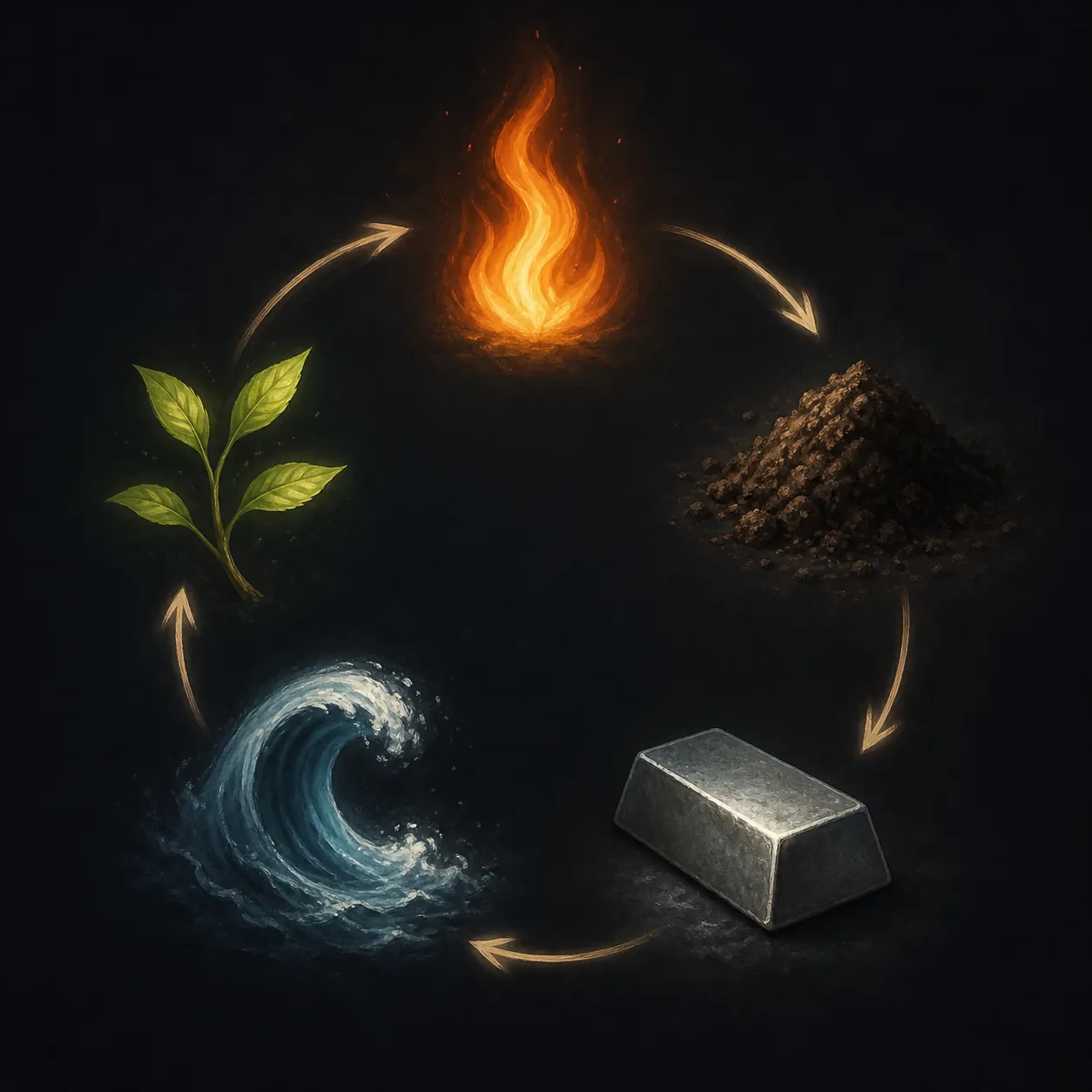
Wuxing, usually translated as the Five Elements or Five Phases, is a traditional Chinese system of correspondences involving Wood, Fire, Earth, Metal and Water. In personality-oriented interpretations, Fire is commonly associated with animation, sociability, expressiveness, joy and the desire for attention. Earth is associated with nourishment, reliability, groundedness and concern for harmony.[4][5][6]
These descriptions are more useful as patterns of movement than as five personality boxes. A person can show several tendencies, and the same quality can become constructive or disruptive depending on circumstance. Expressive Fire may bring warmth to a room; under pressure, the wish to be seen can harden into comparison and resentment. Supportive Earth may hold a group together; overextended, it can become worry or an excessive dependence on relational security.
Ron’s humour is a good example of why the layers should not be separated too neatly. The impulse to joke is lively and expressive, which suits Fire. Its function is often Earth-like: it makes an alarming situation bearable for other people and restores a sense of ordinary companionship. His appetite and enthusiasm similarly make him vivid, but his warmth is rarely abstract. It is enacted through shared food, teasing, arguments, games and the untidy intimacy of family life.
| Evidence in Ron’s character | Fire reading | Earth reading |
|---|---|---|
| Humour during danger or discomfort | Animation and emotional release | Helping the group remain connected |
| Desire for recognition | Need to be noticed and valued | Need to know his place in a relationship |
| Quick anger | Fast, visible emotional escalation | A reaction to threatened belonging |
| Loyalty and protectiveness | Courage and passionate attachment | Reliability, care and responsibility |
| Returning after withdrawal | Renewed conviction and action | Restoration of relationship and duty |
The table is an interpretive synthesis, not a claim that each action carries an objectively measurable elemental label. Its value lies in showing how one behaviour can have more than one dimension. Ron’s longing to matter, for example, is not merely vanity. It is also the longing of someone who measures himself against successful brothers, a famous best friend and a brilliant future partner, then worries that he is the replaceable member of every relationship.
Jealousy as Fire out of balance
Ron’s rift with Harry during the Triwizard Tournament is the most revealing test of the Fire reading. Harry’s selection as an unexpected fourth champion places him at the centre of attention yet again. Ron interprets the event through an existing wound: Harry has somehow found another route to distinction while Ron remains in the audience. Suspicion gives that hurt somewhere to go, allowing him to behave as if Harry’s supposed secrecy is the main offence.[3]
Within this Five Elements interpretation, that is Fire losing proportion. A healthy desire for acknowledgement becomes comparison; admiration becomes irritation; emotional speed outruns reflection. Ron does not calmly examine the evidence and reach a detached conclusion. He feels overlooked, finds an explanation that fits the feeling and withdraws from Harry when friendship is especially needed.
Calling this imbalance is more illuminating than treating jealousy as proof of bad character. Ron’s reaction hurts Harry, and insecurity does not excuse the decision. But the scene works because the grievance grows from recognisable needs: dignity, visibility and assurance that he matters independently of his celebrated friend. The same emotional intensity that makes Ron generous and enthusiastic can make perceived exclusion almost intolerable.
The Horcrux locket attacks that vulnerability with much greater precision. It tells Ron, in effect, that his mother would have preferred a daughter and that Hermione prefers Harry. The taunts combine his oldest fears: being the least wanted child, the least impressive friend and the unsuccessful rival. They do not create his insecurity from nothing, but magnify it until affection looks like a ranking system he is destined to lose.[3]
Here Fire’s need for recognition becomes combustible because Earth’s sense of belonging has also been destabilised. Hunger, fear, exhaustion and the locket’s influence make it harder for Ron to trust the relationships that normally ground him. He lashes out and leaves. The departure is serious precisely because loyalty is central to him: the scene is not exposing a person who never cared, but showing how badly he behaves when he can no longer feel secure in the fact that he is cared for.
His return matters more than his departure
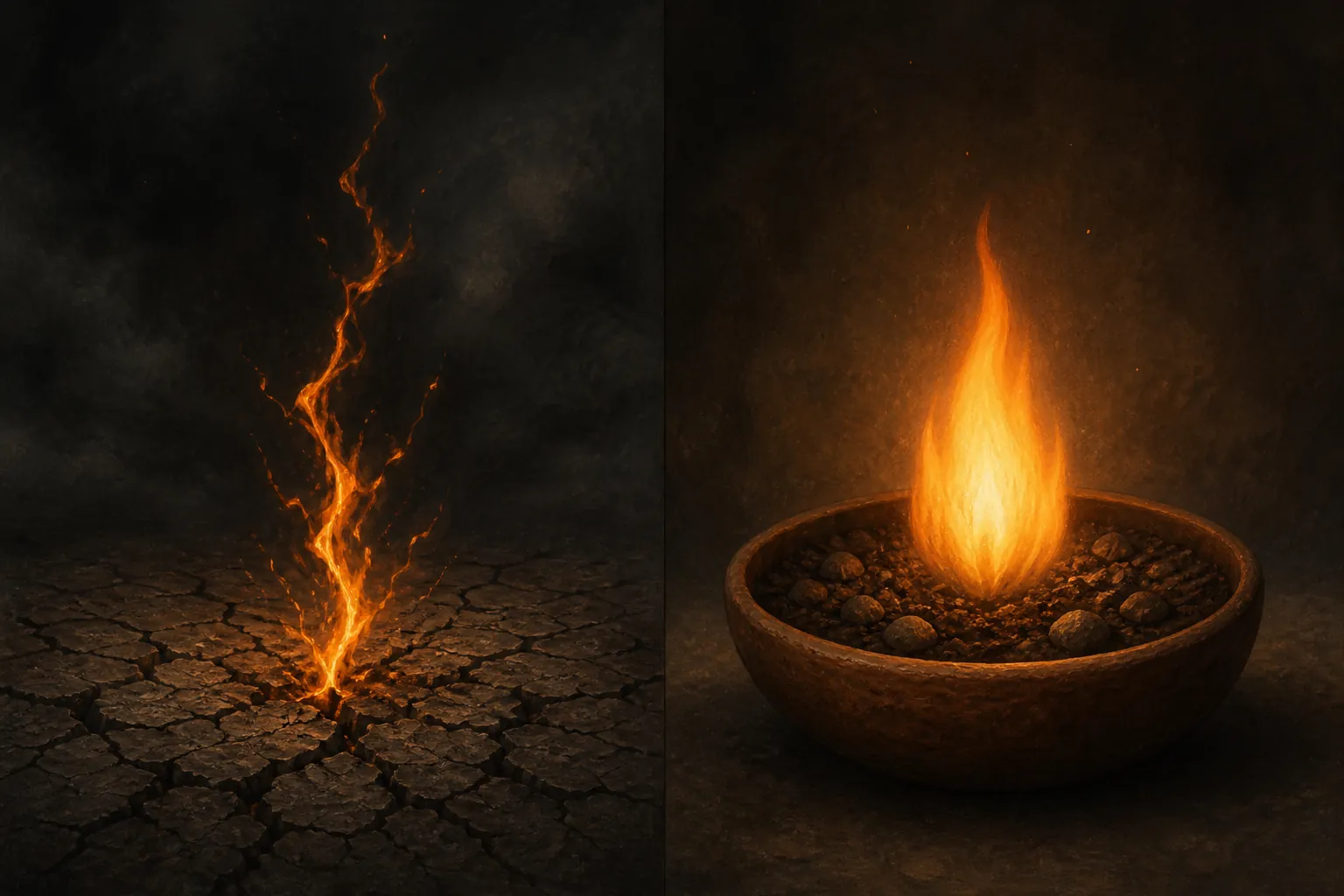
Ron’s growth does not require him to stop wanting recognition. Nor does he become serene, endlessly patient or immune to resentment. What changes is his ability to act in spite of the wound. He returns, rescues Harry and destroys the object that has given his worst comparisons a voice.[3] Fire supplies the courage to act decisively; Earth restores loyalty, responsibility and connection.
That is rebalancing rather than a conversion from a “bad” element into a “good” one. Ron’s anger, humour, enthusiasm and hunger to prove himself all remain recognisably his. They become less destructive when grounded in what he knows through relationship: Harry is his friend, Hermione’s regard is not a trophy to be won, and his place in the struggle depends on choices rather than celebrity.
This also distinguishes him from Gilderoy Lockhart as Fire in excess. Lockhart directs brightness toward image, applause and self-enlargement, with little reliable substance beneath the performance. Ron can also be hungry for attention, but relationship keeps interrupting self-display. He is capable of resentment and retreat, then capable of admitting through action that other people matter more than the grievance.
The Earth layer is more than calling him “the glue”
Describing Ron as the trio’s emotional glue can sound like affectionate fan shorthand unless it is tied to something observable. His contribution is not that he prevents every disagreement; he plainly does not. It is that he gives the friendship a social and emotional texture neither Harry nor Hermione supplies in the same way.
Ron brings Harry into a large, noisy family and offers him access to ordinary wizarding life beyond fame and danger. He gives Hermione someone who will argue with her rather than merely defer to her competence. In crises, he may panic, complain or joke, but he also stands between friends and threats. The official appreciation of Ron emphasises that he stays beside Harry through dangers he could have avoided, while his character record repeatedly pairs protectiveness with courage.[1][2][3]
Most importantly, J.K. Rowling has been quoted as saying that Ron “held the trio together; his humour and his good heart were essential.”[3] That observation gives the Earth interpretation real weight. His grounding role does not depend on pretending he is the calmest or most emotionally stable of the three. Earth appears in the nourishment he provides: belonging, laughter, family, practical familiarity and the conviction that companionship is still possible in frightening circumstances.
Symbolic clues add colour, not proof
Once the behavioural case is established, the surrounding symbolism becomes enjoyable rather than misleading. Ron belongs to Gryffindor, a house associated with Fire; its red and gold are described as representing flames.[7] The correspondence suits his courage, warmth, temper and readiness to act. It also suits the Weasley visual palette, with Ron’s red hair making the association particularly tempting.
One Five Elements personality sketch even mentions red hair and freckles when describing a Fire presentation.[4] That is a resemblance, not evidence that the description was written with Ron in mind or that physical appearance determines personality. The match is memorable because readers already have much stronger behavioural reasons to consider Fire.
His middle name offers another playful echo. “Bilius” is linked to bile, and the traditional humour of yellow bile was associated with Fire and an irritable or bad-tempered disposition when excessive.[7] It is a neat literary detail, especially for a character known to flare up. It remains etymological and symbolic support, not a diagnostic test.
Birth-date calculations would answer a different question. A genuine BaZi analysis requires more than selecting an element from a character’s year, and Ron has no canonical birth time from which to construct a complete chart. Treating a zodiac-year association or an assumed Day Master as the solution would create precision the source material cannot support.
Ron is most revealing, then, as Fire whose desire to shine never disappears. It becomes more generous and dependable when held by Earth: loyalty, responsibility, humour used in service of others and the willingness to return after insecurity has driven him away. This is a culturally grounded descriptive lens for reading a fictional character, not a validated psychological taxonomy, a clinical assessment or a fixed-destiny verdict.
References
- Ron Weasley — Wizarding World
- Why Ron Weasley is our Chosen One — Wizarding World
- Ronald Weasley — Harry Potter Wiki
- What Type Are You? The Five Elements — Yinova Center
- The Five Personality Types — International College of Oriental Medicine
- The Five Elements in Our Personalities — Tao of Wellness
- Elements — Harry Potter Wiki