
A BaZi chart can look like a compact grid of eight unfamiliar Chinese characters. Those characters are not eight separate predictions. They are four pairs, called the Four Pillars: the year pillar, month pillar, day pillar, and hour pillar. Each pillar contains one Heavenly Stem above one Earthly Branch, creating the eight-character structure known as BaZi, or "Eight Characters." [1][2]
The useful first step is therefore structural. Before asking what a chart says about personality, relationships, or timing, identify what each character is doing inside the chart. A BaZi chart is a calendrical snapshot of the birth moment, expressed through stems, branches, elemental associations, and yin-yang polarity. It is not the same thing as a Western-style zodiac horoscope, and it is not a fixed fortune script.
Eight characters arranged as four pillars
A chart is usually displayed in four vertical columns. Reading from one side to the other, the columns correspond to the year, month, day, and hour of birth. The upper character in each column is the Heavenly Stem; the lower character is the Earthly Branch.
| Pillar | What it contains | Common conventional association |
|---|---|---|
| Year | Year Stem and Year Branch | Ancestry, wider social context, and early surroundings |
| Month | Month Stem and Month Branch | Seasonal environment, parents, and formative conditions |
| Day | Day Stem and Day Branch | The self and close partnership relationships |
| Hour | Hour Stem and Hour Branch | Children, aspirations, and later-life concerns |
These associations are traditional reading conventions, not four isolated compartments. A reader does not determine a person's entire identity from the year column, or read the hour column as a complete prediction of later life. The four pillars interact, and their meaning depends on the relationships among the complete set of stems and branches.
The Chinese zodiac animal belongs to the Year Branch, which is only one of the chart's eight characters. It can be a useful mnemonic for the branch, but treating the animal as a personality label leaves out the month, day, hour, the Heavenly Stems, and the elemental relationships that make the chart a chart. [2][3]
The stem-and-branch framework
The Heavenly Stems form a sequence of ten characters. The Earthly Branches form a sequence of twelve. In the traditional calendrical system, the two sequences are paired in order. Because ten and twelve do not share a common divisor larger than one, the pairing returns to its starting point after 60 combinations: the sexagenary cycle. [1][3][4]
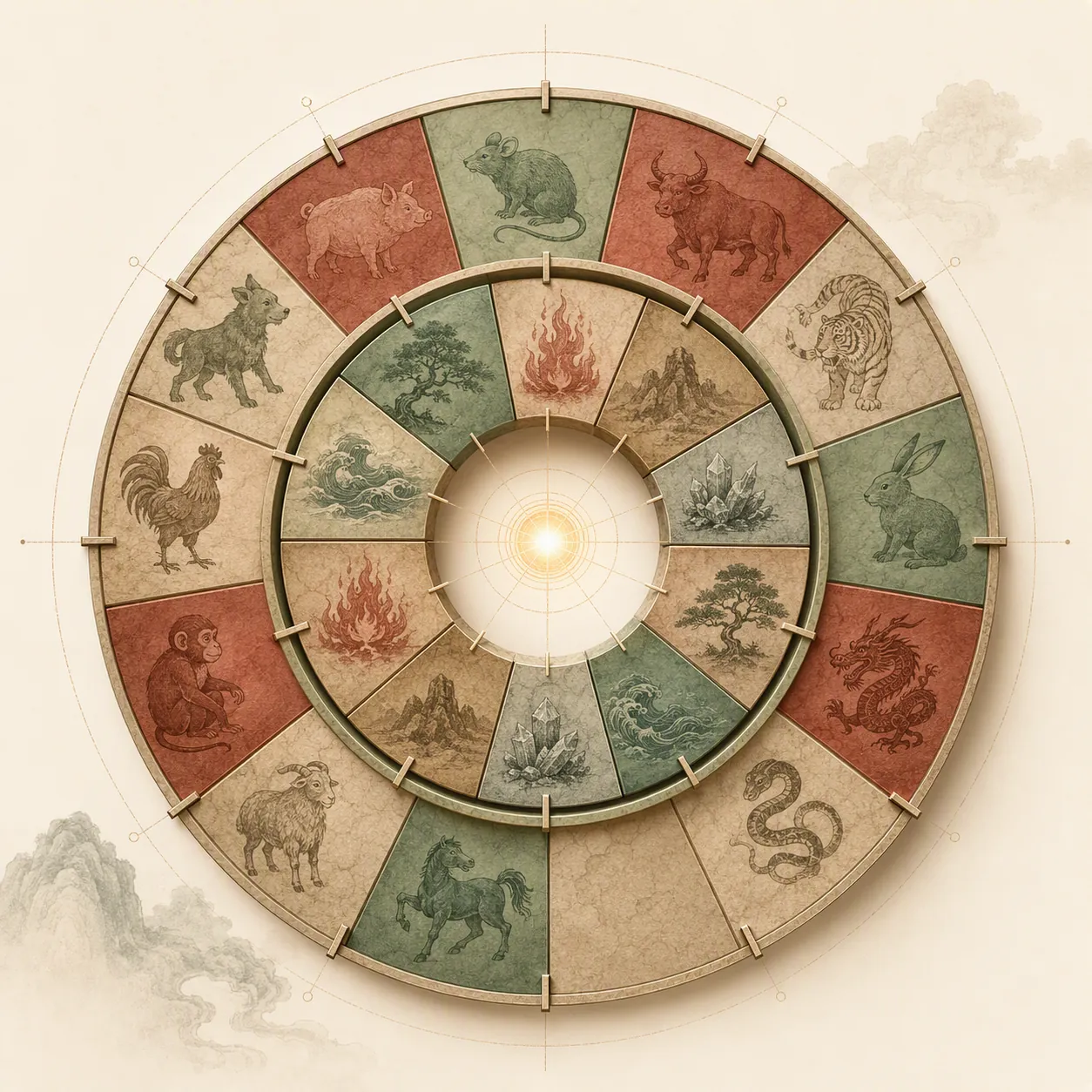
This 60-combination cycle is the mechanical backbone behind the pillar names. A year has a stem-branch designation, as do the month, day, and hour. The same combination does not mean that the four pillars are interchangeable: its significance depends on which pillar it occupies and how it relates to the rest of the chart. The cycle supplies the calendrical coordinates; interpretation adds another layer.
The stems and branches also carry two kinds of information that are often shown through color or symbols in a calculator. Each is associated with one of the Five Elements and with a yin or yang polarity. A character is therefore more than a pictorial label or animal sign: it participates in a repeating system of polarity and elemental relationships.
Five Elements and the two relationship cycles
The Five Elements are Wood, Fire, Earth, Metal, and Water. In BaZi, they are better understood as a relationship vocabulary than as five physical substances sitting inside a person. The characters in a chart are assigned elemental qualities, allowing a reader to examine which elements are prominent, which relationships connect them, and how seasonal context affects the reading.
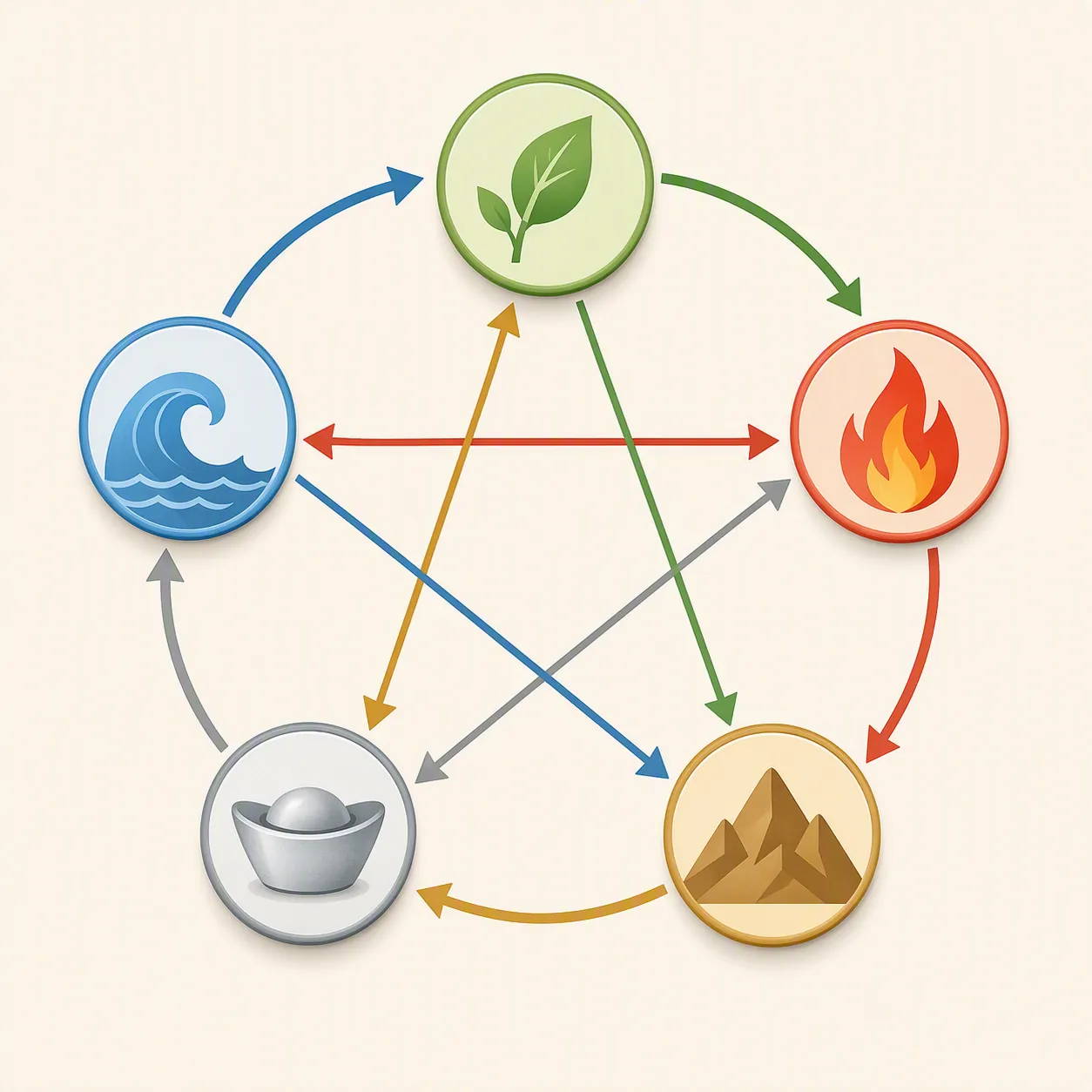
Two cycles provide the basic grammar. The producing cycle runs Wood to Fire, Fire to Earth, Earth to Metal, Metal to Water, and Water to Wood. It describes a sequence of generation or support. The controlling cycle describes a restraining relationship: Wood parts Earth, Earth absorbs Water, Water extinguishes Fire, Fire melts Metal, and Metal chops Wood. [1][2]
These cycles do not amount to a scorecard in which more of one element is automatically good and less is automatically bad. A chart is read in context, including the season represented by the month pillar and the position of each element. The same element can play different roles depending on the chart's reference point and the relationships surrounding it.
Yin and yang add another distinction within each element. For example, Wood has a yin and a yang expression, as do Fire, Earth, Metal, and Water. The ten Heavenly Stems result from combining the five elements with these two polarities. This is why a chart can distinguish between two stems that belong to the same element without treating them as identical. [4]
The Day Master is the chart's reference center
The Day Master is the Heavenly Stem of the Day Pillar. It is one specific character in the eight-character chart, not a separate sign calculated from the month. Once the day pillar has been established, its upper stem becomes the reference center against which the other stems, branches, elements, and relationships are considered. [1][2][5]
This makes the Day Master a practical starting point for interpretation. A chart may contain Wood, Fire, Earth, Metal, and Water, but the question is not simply how much of each appears. The interpreter asks how those qualities relate to the Day Master's element and polarity, taking the whole arrangement into account.
The distinction matters because the Day Master changes with the day, not with the month. It is therefore not equivalent to a monthly sun sign. Two people born in the same month can have different Day Masters, and two people who share a zodiac animal can have very different day, month, and hour pillars.
What lies beneath the visible characters
A calculator may show additional rows beneath or beside the eight main characters. One common layer is the hidden stems, or cang gan: stems traditionally contained within an Earthly Branch. They are part of why a branch is not treated as a single, simple symbol. Different schools can vary in how they describe the composition of particular branches, so a calculator's hidden-stem display should be read as a convention of its method rather than an unquestioned universal table. [3][6]
Another later layer is the Ten Gods. Despite the name, these are not deities in the ordinary sense. They are relational categories calculated from the Day Master's element and polarity in relation to other chart components. They can be useful in a fuller reading, but they are not required to identify the basic structure of a BaZi chart. [7]
Why birth time, place, and calendar rules matter
The month pillar is not assigned simply by looking up the month in a lunar calendar. BaZi month boundaries follow the 24 solar terms, which divide the solar year according to the Sun's position. A birth near a solar-term boundary can therefore receive a different month pillar from one produced by a calculator using a simple lunar-month assumption. [1][3]
The hour pillar uses twelve shichen, traditional two-hour periods. That makes the recorded birth time important even before any interpretation begins. Birthplace matters because clock time and local solar time are not always the same. Some methods adjust for true solar time, while others use standard civil time. The choice can change the Hour Pillar, particularly near a two-hour boundary. [1][9][10]
Day boundaries are another source of variation. Schools and calculators may differ over when one BaZi day ends and the next begins. For a birth close to that boundary, the Day Pillar, and consequently the Day Master, may change. This is why two calculators can produce different Hour Pillars, or in some cases different Day Masters, from apparently identical birth details. The disagreement may reflect a difference in time-zone handling, true-solar-time adjustment, or day-boundary convention rather than a simple arithmetic error.
For a meaningful comparison, check the original date, exact local birth time, birthplace, time zone, daylight-saving treatment, solar-term rule, and day-boundary method. A chart output without those assumptions is harder to reproduce than it appears.
What a BaZi chart can and cannot tell you
At the structural level, a BaZi chart records the stem-branch and elemental framework associated with a person's birth date, time, and place. It gives an interpreter an organized system for discussing seasonal influence, elemental relationships, polarity, and the Day Master as a reference point.
It does not independently establish a personality from one animal, guarantee a future event, or remove the effects of choice and circumstance. Claims about what a chart can predict require more support than the existence of the eight characters themselves. The chart is the constructed starting point; interpretation is a human and school-dependent process.
Once the stems, branches, Five Elements, calendar basis, and Day Master are clear, the next practical step is learning how to read a generated result. The guide How to Interpret Your BaZi Calculator Results takes up that interpretive layer. For a related calculator guide, How to Use a Zi Wei Dou Shu Calculator Correctly follows the same practical discipline of checking birth date, time, time zone, birthplace, and any true-solar-time assumptions before attaching meaning to the output.
References
- Four Pillars of Destiny — Wikipedia
- Beginner's Guide to Bazi Reading — Imperial Harvest
- Ba Zi/Earthly Branches — Wikibooks
- BaZi Heavenly Stems — SkillOn
- How to Read a BaZi Chart — Eastern Fate
- The 12 Earthly Branches — Imperial Harvest
- The Ten Gods — Imperial Harvest
- Hidden Stems in BaZi — Bazi Fortune
- True Solar Time and BaZi Calculations — OpenFate
- BaZi Time and Day Boundary Conventions — Master Sean Chan