The August 27, 2026 lunar eclipse’s Chinese-calendar meaning begins with an apparent date conflict. Eclipse catalogs use August 28 because the event reaches its greatest phase at 04:13 UTC. Across much of the Americas, however, that is still the evening of August 27. It is during this local evening that the visible eclipse overlaps with 七月十五, the 15th day of the seventh Chinese lunar month and the date of 中元节, the Ghost Festival.
Astronomically, this is a deep partial lunar eclipse, not a total eclipse or a “blood moon.” The penumbral phase begins at 01:23 UTC on August 28, the partial phase lasts from 02:34 to 05:52 UTC, and 96.2% of the Moon’s area enters Earth’s umbral shadow at maximum.[1] The Chinese calendar places August 27 on 七月十五 in the 丙午 Bing-wu, or Fire Horse, year.[2]
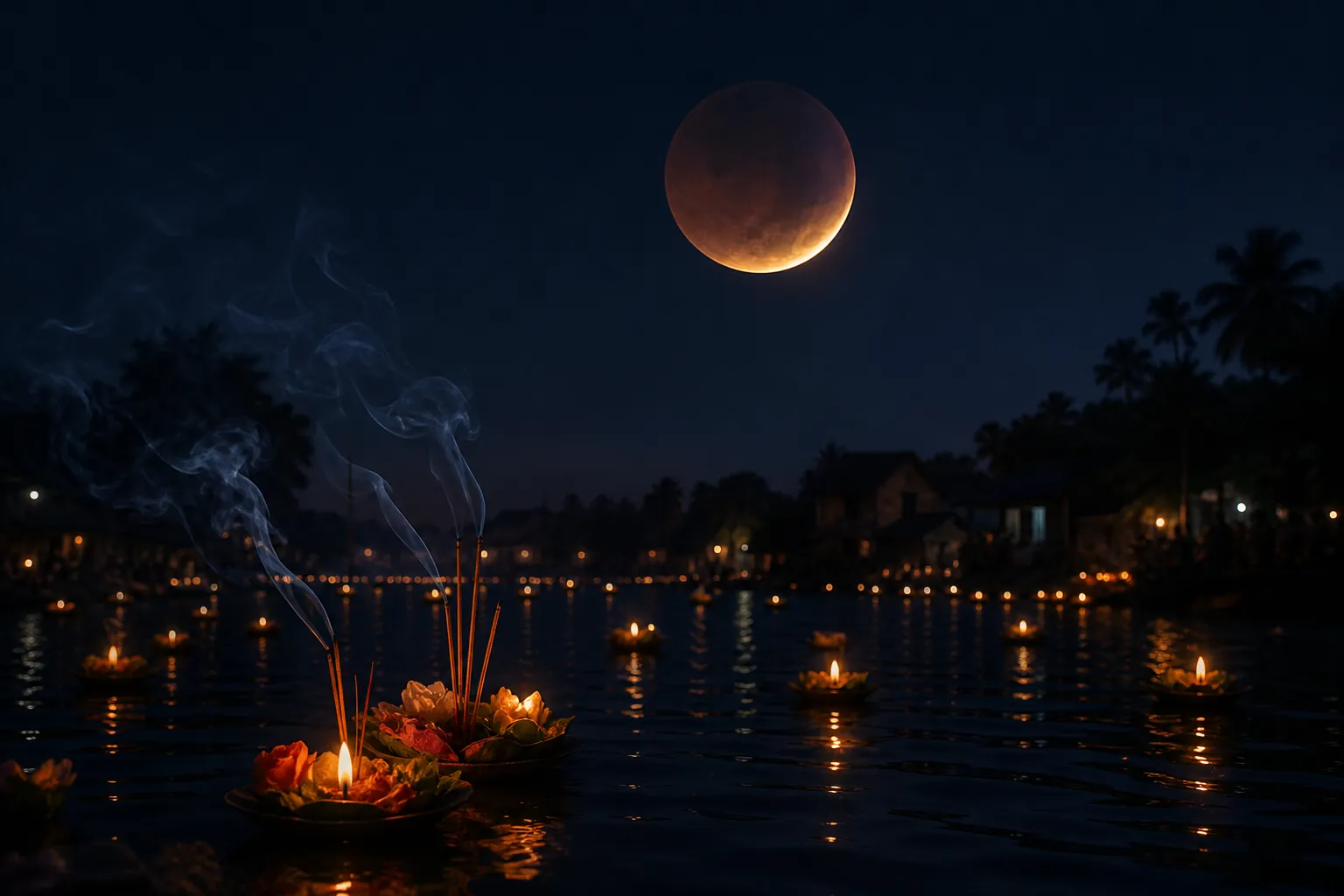
These facts produce a genuine overlap for communities observing the festival on the evening of August 27 in the Americas. In China and elsewhere in East Asia, the eclipse occurs after the Moon has set and during daylight on August 28, so it cannot be watched there. That visibility difference does not remove the festival’s significance: families may observe 七月十五 on its local calendar date whether or not the eclipse is above their horizon.
| Layer | What can be stated |
|---|---|
| Astronomy | A 96.2%-area deep partial lunar eclipse reaches maximum at 04:13 UTC on August 28.[1] |
| Chinese calendar | August 27 is the 15th day of the seventh lunar month in the Bing-wu Fire Horse year.[2] |
| Established custom | 中元节 centers on remembrance and offerings; many families avoid scheduling weddings, moves, and business openings during Ghost Month.[3] |
| Cultural synthesis | Calling the coincidence a “double-yin” night is a reasoned interpretation, not a fixed classical doctrine or a verified almanac verdict. |
What 七月十五 means before the eclipse is added
The seventh lunar month is widely known as Ghost Month. In 2026 it runs from August 13 through September 10, with the full moon on the 15th day treated as its traditional peak. 中元节 is associated with honoring ancestors, making offerings for wandering spirits, burning incense, chanting, and presenting food or paper offerings. In Daoist observance, the date is also connected with the Earth Official, 地官大帝, who is believed to examine deeds and grant pardons.[3]

Practices differ by family, region, and religious background. One household may prepare a substantial offering table; another may light incense, recite prayers, visit a temple, or quietly remember deceased relatives. The common thread is attention directed toward the dead and toward obligations that ordinary routines can push aside.
The customary restraint surrounding the month follows from that atmosphere. Many families postpone weddings, moving into a new home, opening a business, or beginning another conspicuously celebratory undertaking.[3] This is a social and ritual judgment about timing. It does not establish that every event started during the month will fail, nor does it prove that misfortune is caused by the date.
What the eclipsed Moon adds
A lunar eclipse is 月食, literally the Moon being “eaten.” Chinese folklore often personified the eater as 天狗, the celestial dog. Communities made noise with gongs, drums, firecrackers, and household vessels in an effort to frighten the creature away and rescue the Moon. Other versions imagined a dragon or a three-legged toad consuming it.[4][5]
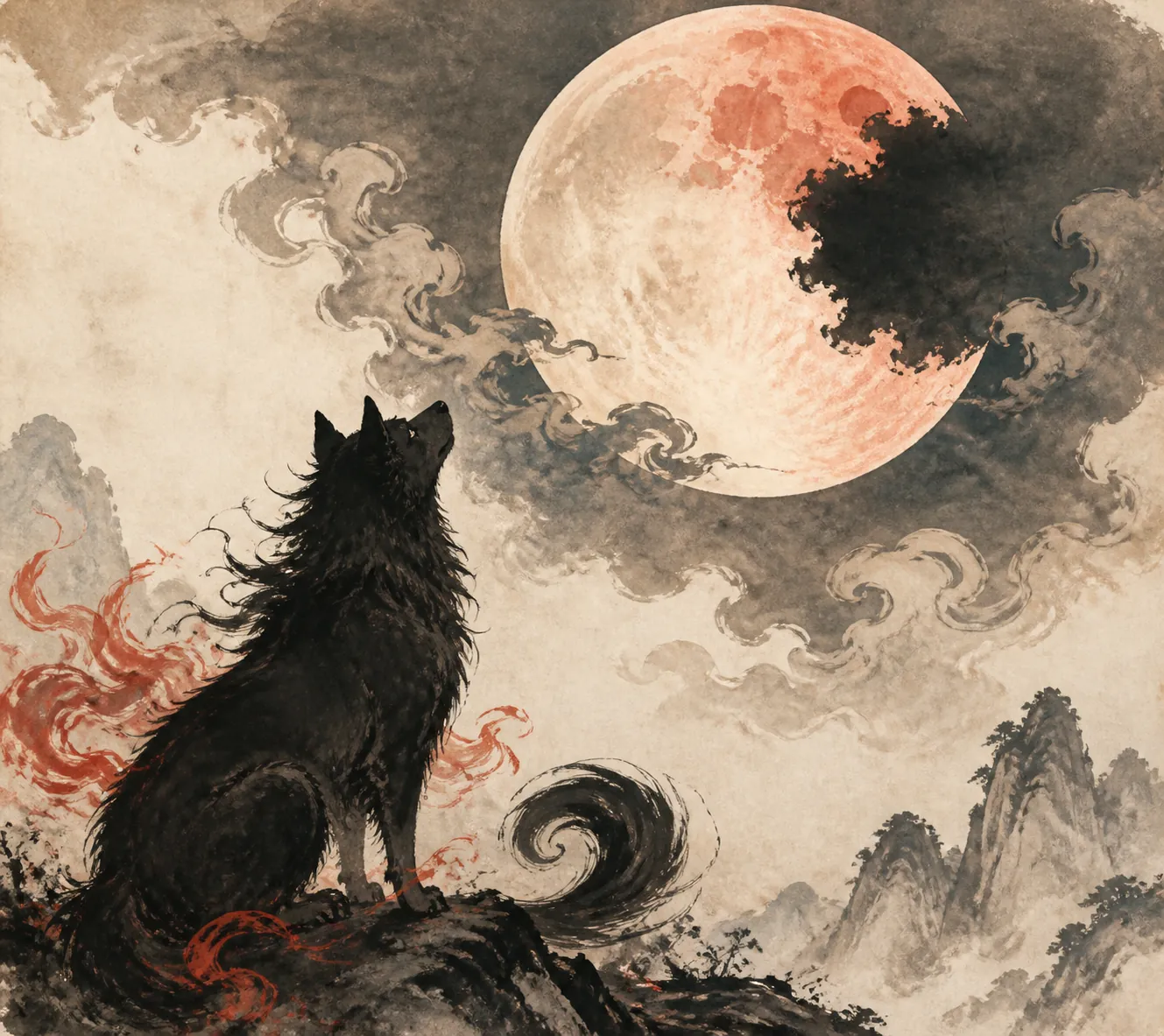
Such images belong to the cultural history of eclipses; they are not explanations of the physical event. Court traditions could also treat an eclipse as a warning about disorder in the relationship between heaven, the ruler, and society.[4] Modern astronomy instead explains a lunar eclipse through Earth’s shadow crossing the full Moon. A fuller account of the full-moon mechanics, reddish color, and older ritual background appears in Why the Moon Turns Red at Full Moon in the Chinese Calendar.
On an ordinary date, that historical symbolism would be sufficient reason to treat eclipse hours as a period for watching and reflection rather than for dramatic predictions. Here, however, the Moon is darkened during the full moon already devoted to remembrance of the dead. The two layers reinforce the same mood: one comes from the established festival calendar, while the other comes from eclipse imagery and the visible interruption of the full Moon.
Is this really a “double-yin” night?
“Double-yin” is useful as interpretive shorthand, provided it is not passed off as an ancient rule. One layer is the seventh-month festival’s association with ancestors, spirits, offerings, and inward attention. The second is the temporary darkening of the Moon, the celestial body conventionally placed on the yin side of the yin-yang pairing.
There is no established classical doctrine specifically for a lunar eclipse falling on 中元节. The meaning comes from bringing two independently verified facts together. It is therefore reasonable to read the date as unusually concentrated in yin imagery, but not to claim that tradition assigns it a guaranteed supernatural effect.
Nor does the festival date supply a complete day-selection verdict. A formal almanac judgment would require verified day-level 宜 and 忌 information and its underlying calendrical method. Without that evidence, declaring the day categorically auspicious or inauspicious would manufacture precision that the festival customs alone cannot provide.
How to treat the evening
For someone who wants to respect the Chinese-calendar setting, the most fitting activities are modest ones: observe the Moon, spend time quietly, remember deceased relatives, prepare a family offering, light incense where it is safe and permitted, chant or pray according to household practice, or record family stories that might otherwise be lost.
- Weddings and major celebrations: postponement is consistent with documented Ghost Month custom where the schedule remains flexible.
- Moving house or opening a business: choose another date if doing so matters to the family members or partners involved.
- Necessary work, travel, or existing commitments: proceed without treating the eclipse as a prediction of harm.
- Ancestor observance: follow family and regional practice rather than assuming that one style of offering is universal.
A wedding already arranged need not become a source of fear, and a necessary move does not become doomed because rescheduling is impossible. The practical reason to pause is that the festival already asks for remembrance and restraint, while the eclipse intensifies that atmosphere for those able to see it.
For date selection, August 27–28 is best treated as an observe-and-pause window rather than a launch window. That remains a modest cultural judgment, not a sentence of fate—and it still applies as a way of honoring the festival even where the eclipsed Moon is below the horizon.
References
- August 27–28, 2026 Partial Lunar Eclipse. timeanddate.
- 2026 Gregorian-Lunar Calendar Conversion Table. Hong Kong Observatory.
- Hungry Ghost Festival 2026. WOFS.com.
- A Brief History of the Solar Eclipse. The World of Chinese.
- Lunar eclipse. Wikipedia.