The strange thing about AI astrology is that it can sound most confident at exactly the moment it has stopped doing astrology. A chatbot may name your Sun sign correctly, describe it fluently, then place your Moon in the wrong sign or invent an Ascendant that changes every house in the chart. To a beginner, that feels like a personal mismatch. Technically, it is usually simpler: the model has moved from interpreting a chart to guessing one.
The Sun sign is forgiving. It follows broad date ranges, appears constantly in public writing, and is easy for a text model to imitate from patterns in its training data. The Moon, rising sign, house cusps, Vedic nakshatras, dasha dates, BaZi pillars, and Zi Wei Dou Shu placements are not forgiving in the same way. They depend on exact birth data, time zone handling, calendar rules, house systems, and calculation methods. A sentence generator can describe those things, but description is not computation.
The Error Pattern Is Not Random
A vendor-published drift test from RoxyAPI shows the split clearly. In its example, a free-hand frontier-model chart kept slow outer planets close enough to look impressive, with a mean error of about 0.5 degrees, but drifted by a mean of about 8.3 degrees across fast-moving bodies plus the Ascendant. Venus was reported about 23 degrees off, and the Ascendant landed in the wrong sign, which rotated all 12 house cusps.[1]
That is vendor-published test data, not a neutral industry benchmark. Still, the pattern is useful because it matches the kind of failure users actually notice. Slow bodies can be approximately right because they move slowly. The Sun can often be right because it is tied to familiar date ranges. The Moon changes quickly enough that a small time or date assumption can matter, and the Ascendant is even more sensitive because it depends on birth time and location. Once the Ascendant is wrong, the house cusps are no longer a small mistake; the chart frame itself has shifted.
AstrologyAPI describes a similar pattern from its own testing: a bare language model gets the Sun sign right almost always, the Moon sign only about half the time, and rising signs, house cusps, nakshatras, and dasha dates are effectively fabricated when no calculation engine is attached.[2] Again, the source sells astrology infrastructure, so the marketing layer deserves caution. The useful part is the named failure mode: fluent text makes a fabricated chart feel like a calculated chart.
| Chart element | Why a bare LLM may appear right | Why it can fail |
|---|---|---|
| Sun sign | Common date ranges are widely repeated in text | Cusp dates still require exact year and time-zone care |
| Moon sign | The model may know a plausible nearby placement | The Moon moves fast enough that birth time and location can change the result |
| Ascendant | The model can write convincing rising-sign prose | The calculation depends on birth time, place, and local sky rotation |
| House cusps | House meanings are easy to describe in general | Cusps depend on the Ascendant and chosen house system |
| Nakshatra and dasha details | Vedic terminology appears in training text | The actual sequence requires computed lunar positions and system rules |
| BaZi pillars | The model can imitate Five Elements language | Pillars require rule-based calendar calculation, not memory |
AI Astrology Has Two Jobs, and Only One of Them Is Writing
A trustworthy AI astrology system separates two jobs. First, a deterministic chart engine calculates the chart. Second, a language model explains the verified placements. Most confusion begins when those jobs are collapsed into one chat box.
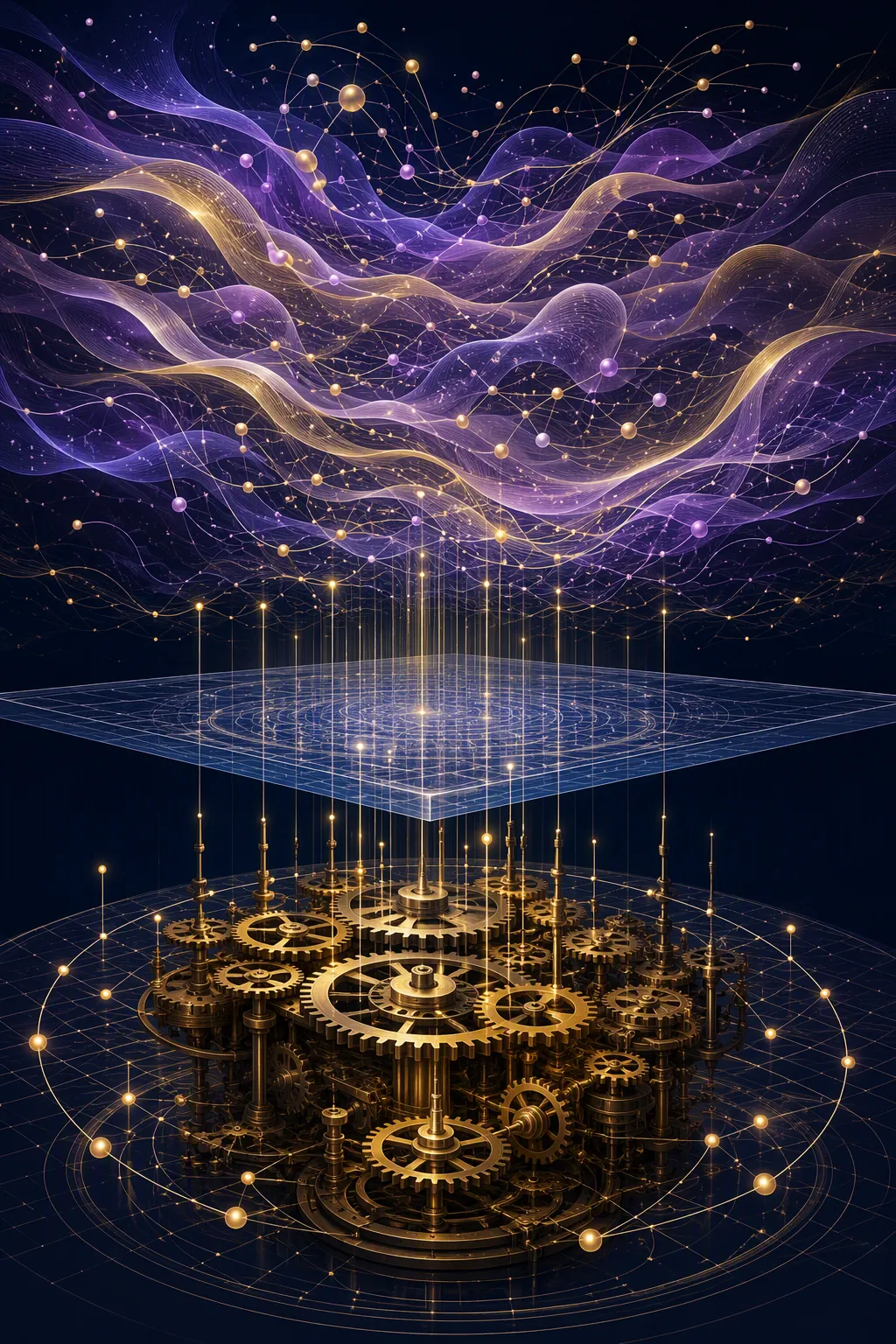
In Western astrology, the calculation layer usually means ephemeris math: planetary positions are computed from astronomical data, then houses are derived from birth time, birth place, and a selected house system. SteerCorp and AstrologyAPI both describe real chart engines as tracing to the Swiss Ephemeris and NASA JPL DE431 data, with sub-arcsecond accuracy claims attributed to that technical lineage.[2][3] The published sources do not agree on a single coverage range, so the honest point is not a slogan about all time periods. The point is that serious products use a calculation source instead of asking a language model to remember the sky.
The language layer starts after that. It receives something like: Sun in Gemini at a stated degree, Moon in Scorpio, Virgo rising, Mars in the tenth house, and so on. From there, an LLM can compare meanings, soften technical language, organize a reading, and adapt tone for the reader. That is a legitimate use of generation. It is not the same as letting the model supply the placements from memory.
A grounded workflow looks plain, which is part of its strength:
- Collect birth date, exact birth time, and birth place, including any uncertainty around the recorded time.
- Normalize the data: time zone, daylight saving rules, calendar conventions, coordinates, and the house or zodiac system being used.
- Compute the chart through an ephemeris-backed engine for Western or Vedic positions, or a rule-based calendar engine for systems such as BaZi.
- Pass only the verified placements, degrees, houses, pillars, or star positions to the AI text layer.
- Make the output show its assumptions: house system, zodiac, birth time uncertainty, calendar conversion, and any limits in the interpretation.
This workflow is less glamorous than asking a chatbot for a complete reading in one request, but it protects the reader from the most damaging error: polished interpretation attached to false inputs.
Where the Chatbot Usually Goes Wrong
The first failure is missing birth precision. A person may enter only a date and city, then receive a rising sign anyway. That should be treated as a warning, not a convenience. Without birth time, the Ascendant and houses cannot be securely calculated. A responsible tool either asks for the missing time, offers a time-unknown chart without houses, or labels the result as uncertain.
The second failure is hidden format interpretation. CNET’s practical test of making a birth chart with AI found that even when a computed chart was fed to ChatGPT for interpretation, the model could misread date formats by swapping month and day, and the user had to correct it.[4] That is not a planetary calculation problem. It is a data-handling problem, and it is exactly the kind of small mismatch that can make a reading feel mysteriously wrong.
The third failure is system ambiguity. Western tropical, Western sidereal, Vedic, whole-sign houses, Placidus houses, BaZi solar-term rules, and Zi Wei Dou Shu charting conventions are not interchangeable labels for the same output. If a product does not tell the user which system calculated the chart, it has made comparison almost impossible. The reader is left checking the Moon sign or rising sign as if there were one universal setting behind the screen.
The fourth failure is prose overreach. Once a model has invented a placement, it can still write a beautiful paragraph about it. That paragraph may be emotionally useful in the moment, but it is not evidence that the chart was calculated. This is why the most important trust signal is not whether the reading sounds mystical, compassionate, or specific. It is whether the product can show what calculated the underlying chart.
Chinese Astrology Makes the Same Boundary Even Clearer
BaZi is a useful test case because its structure is openly rule-based. A Four Pillars chart is not produced by poetic association first; it is built from year, month, day, and hour pillars derived through calendar rules. A reader who wants the calculation side can start with what a BaZi chart actually contains; the important point for AI astrology is that a language model should not be inventing those pillars from a birth date in free text.
Master Tsai’s Chinese Fortune Calendar material states the issue directly: ChatGPT cannot generate a correct BaZi chart on its own, and the site’s approach is to provide downloadable rule-based models that teach Year, Month, Day, and Hour pillar calculation, with reasoning or deep-thinking modes needed for the process.[5] The valuable lesson is not that one file solves all interpretation. It is that pillar math belongs in a rule system before interpretation begins.
Zi Wei Dou Shu has the same practical demand for accurate inputs and conversion. Before asking an AI to explain palaces, stars, or life themes, the chart itself needs to be generated under the right rules. That is why a calculator workflow that emphasizes birth data and conversion, such as a guide to using a Zi Wei Dou Shu calculator correctly, is not a boring technical preface. It is the foundation for any reading that follows.
There is also a cultural-language nuance here. An arXiv CSCW study based on 22 interviews and 1,842 posts found that some Chinese user communities reported Chinese-trained models as more fluent with BaZi, Zi Wei Dou Shu, and Five Elements meanings.[6] The same study’s sample was young, educated, and female-skewed, so it should not be stretched into a claim about all users. It does support a narrower point: cultural fluency in interpretation can vary by model and community, but fluency still does not replace chart calculation.
What to Check Before Trusting an AI Reading
The fastest check is to ask what calculated the chart. A serious answer should name an ephemeris, astrology engine, calendar engine, or calculation method. A weak answer will talk only about model intelligence, personalization, or being trained on astrology texts. Training on astrology writing may help the prose. It does not calculate your Moon degree.
The next check is whether the system admits uncertainty. If your birth time is approximate, the tool should say what becomes unstable. If you do not know your birth time, it should avoid pretending to know the Ascendant and houses. If you are using BaZi or Zi Wei Dou Shu, it should be clear about calendar conversion and the rules used to build the chart. A product that hides these assumptions may still produce an elegant reading, but it has made verification harder for the person who needs it most.
It is fair to want guidance from AI astrology. People ask these questions because a chart can give language to timing, temperament, conflict, grief, desire, or the sense that a life pattern is repeating. The problem is not the search for meaning. The problem is when the tool turns that search into a confidence trick by presenting guessed placements as computed facts.
A useful AI astrology product computes first and interprets second. It treats planetary positions, house cusps, dashas, BaZi pillars, and Zi Wei Dou Shu charts as structured outputs from an engine, not as words to be improvised. When that boundary is respected, AI can help explain a chart in clearer language. When a language model supplies degrees, signs, pillars, or cusps from memory, the polished reading is only polished text.
References
- Why AI Chatbots Hallucinate Birth Charts and How to Fix It — RoxyAPI
- Why ChatGPT can't calculate your birth chart — AstrologyAPI
- AI Astrology: Real Calculations vs AI Hallucinations — SteerCorp
- Make an Astrology Birth Chart With AI? Here's How — CNET
- Master Tsai AI Bazi Chinese Astrology Model — Chinese Fortune Calendar
- "Re-Tell the Fortune so I Can Believe It": How Chinese User Communities Engage with and Interpret GenAI-based Fortune-Telling — arXiv