When a free BaZi calculator gives you one chart and another free calculator gives you a different Hour Pillar, Month Pillar, or even Year Pillar, the first thing to check is not your interpretation. It is the calculation layer. Four Pillars charts are built from calendrical decisions, and small differences in those decisions can produce a different chart from the same birth details.
The visible disagreement usually comes from a short list of choices: whether the tool adjusts clock time into true solar time, how it handles solar-term boundaries, whether it changes the year at Lichun or Chinese New Year, which zi-hour convention it uses, and whether it has reliable historical timezone and daylight-saving data. None of those choices is solved by picking the prettiest interface.
The hour issue is the easiest place to see why this matters. In the Four Pillars system, the Hour Pillar is assigned across twelve two-hour periods in the day, so a birth time does not need to move very far to cross from one pillar into another.[1]
The Two-Hour Boundary Is Where Many Disagreements Begin
Suppose a baby is born in Singapore at 2:00 pm by the hospital clock. Singapore uses UTC+8, whose standard meridian is 120°E. Singapore is near 104°E. That longitude difference alone puts local solar noon roughly 64 minutes behind the zone’s standard meridian, because the common correction uses 4 minutes per degree of longitude.[2]
Then the equation of time is added. Sources describe this seasonal correction in slightly different ways; DestinySeek gives the annual swing as roughly -14 to +16 minutes, while other BaZi-oriented explainers emphasize that the combined effect can be large enough to matter near a boundary.[3][4] If the equation-of-time component on that date is small, the Singapore 2:00 pm clock time can land at roughly 12:55 pm true solar time. That is not a random chart change. It is a birth time being moved across a two-hour pillar boundary after longitude and solar correction.
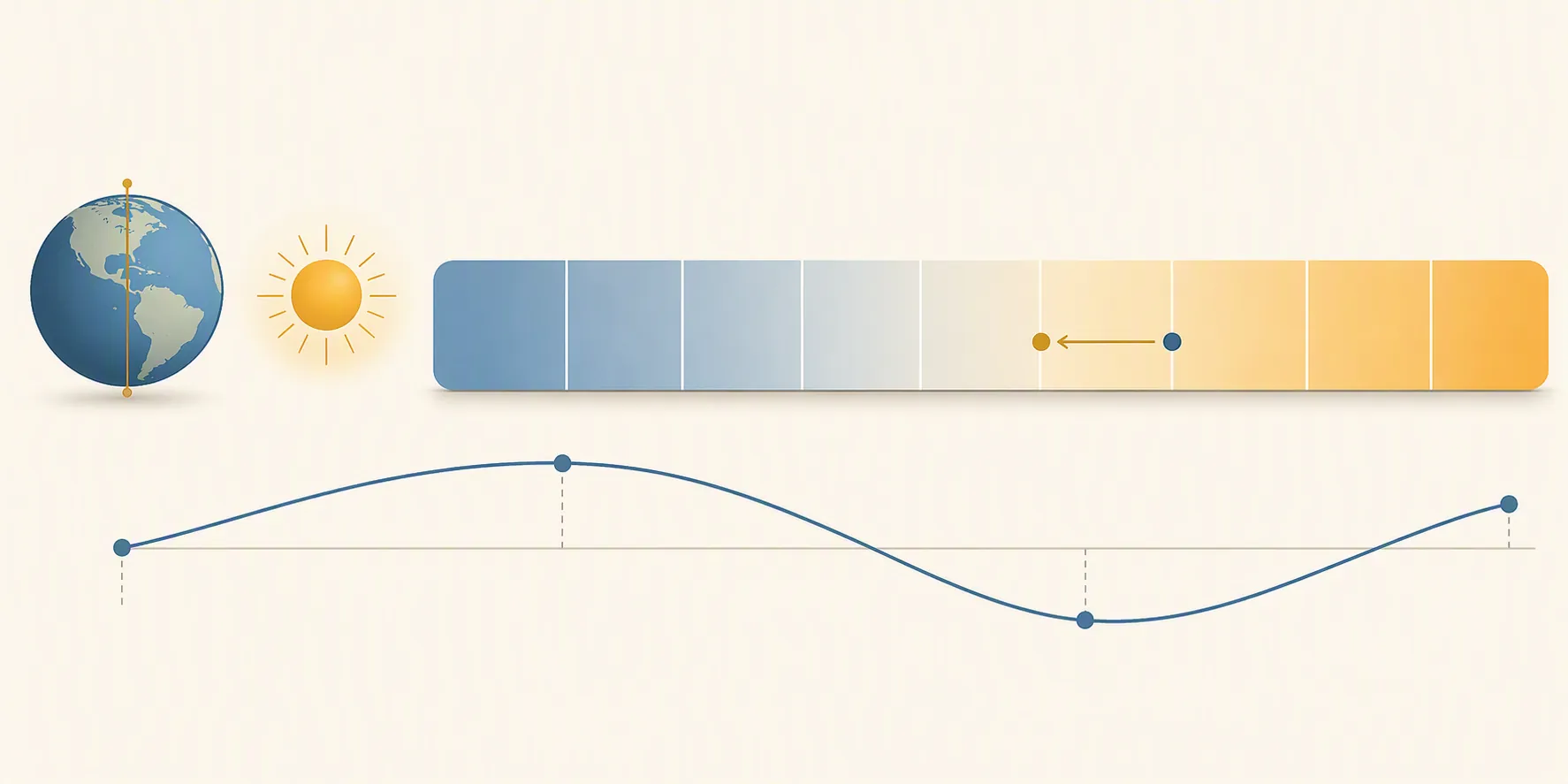
This is also why true solar time does not change every chart. If the corrected time stays inside the same two-hour block, the Hour Pillar remains the same. If the birth time sits close to a boundary, a correction of 30, 45, or 65 minutes can be decisive. A calculator that asks only for clock time and country may quietly produce a different result from one that asks for city of birth and applies longitude correction.
What True Solar Time Actually Means
True solar time is not a mystical refinement. It is an attempt to place the birth time against the local apparent sun rather than against a legal clock. A timezone clock treats every place inside the zone as if it shared the same standard meridian. The sun does not. Cities east of the standard meridian experience local solar time earlier; cities west of it experience local solar time later.
The plain version of the calculation is: compare the birthplace longitude with the timezone’s standard meridian, convert each degree of difference into about four minutes, then add the equation-of-time adjustment for the date.[2][3] BaZi calculators that expose this setting may label it “true solar time,” “local solar time,” or “longitude correction.” Some leave it on by default. Some leave it off. Some do not say.
| Input Detail | Why It Matters |
|---|---|
| Birthplace city | Needed to estimate longitude correction instead of using only the timezone. |
| Timezone | Needed to know the legal clock offset and the zone’s standard meridian. |
| Date | Needed for the equation-of-time adjustment and for historical timezone or DST rules. |
| Clock time near a two-hour boundary | The place where a correction is most likely to change the Hour Pillar. |
A clean calculator does not have to force one school on every user, but it should tell the user what it did. “True solar time: on” is more useful than a polished chart that hides the fact that the clock time was adjusted before the Hour Pillar was calculated.
Month Pillars Follow Solar Terms, Not Lunar Months
The next common split is the Month Pillar. People often assume that a Chinese metaphysics chart must follow lunar months, so a calculator that changes the month before or after a lunar calendar date can look suspicious. In BaZi, the Month Pillar is tied to the solar-term system rather than ordinary lunar months.[1]

That matters most around the boundaries between solar terms. A birthday near the beginning of a solar month may sit on one side of the boundary in one calculator and on the other side in another if the tool uses a different ephemeris, timezone assumption, or boundary convention. The chart has not become ambiguous in a poetic sense; the calculator has made a calendrical decision.
The Year May Change at Lichun
The Year Pillar creates a separate February problem. Many BaZi systems treat the year boundary as Lichun, the Beginning of Spring solar term, which usually falls around February 3 to 5, rather than Chinese New Year.[5] For someone born in early February, two calculators can disagree because one has used the solar-term year and another has followed the lunar new year.
This is not a minor interface preference. The Year Pillar can change. If your birthday falls in late January or early February, the calculator should state which year boundary it uses. If it does not, you may need to test the same birth details in a tool that explicitly names Lichun handling, then compare the year pillar rather than accepting the first output.
Zi Hour Is a Convention, Not a Typo
Birth times around 11:00 pm to 1:00 am have their own trap. The zi hour spans 23:00 to 01:00, but schools differ on whether late zi hour belongs to the same calendar day or should be treated as the next day for certain calculations. FateMaster’s calculator notes that zi-hour and Lichun handling can depend on school convention, which is exactly the kind of disclosure users need before interpreting a chart.[5]
If you were born nowhere near 23:00, this may not affect your chart. If your recorded time is 23:30, it can affect the Day Pillar and the Hour Pillar together, which is why a calculator’s zi-hour rule should be visible before you trust its output.
Historical Timezones and DST Can Move the Date
For modern births in places with stable timezone rules, the timezone field may feel routine. For historical births, cross-border births, or places that changed daylight-saving rules, it is not routine. A one-hour DST difference can push a time across a two-hour pillar boundary. Near midnight, it can also change the date used for the Day Pillar.
This is where vague location input becomes expensive. A calculator that asks only for “country” may not be using the same historical timezone assumption as one that asks for city and date. The problem is not that one tool is necessarily careless. The problem is that the user cannot audit the result unless the tool tells them how timezone history was handled.
Where AI Chatbot Answers Fit
AI chatbots can be useful for explaining terms, comparing interpretations, or helping a beginner read a chart that has already been calculated. They are weaker as the source of record for the calendrical chart itself. DeepOracle’s 2026 comparison reported that general AI tools could return divergent Day Masters or Hour Pillars for the same birth information, although that source is promotional and ranks its own product first, so the finding should be treated as one vendor’s test rather than an independent benchmark.[6]
The practical distinction is simple: use a calculator for calculation and use interpretive text after you know which chart you are reading. If an AI answer does not state the timezone, true solar time setting, Lichun rule, and zi-hour convention, it has not given you enough information to verify the pillars.
How to Check a Free BaZi Calculator Before You Trust It
You do not need to become a calendar technician. You do need to ask a few concrete questions before building an interpretation on the chart.
- Does the calculator ask for birthplace, not just date and clock time?
- Does it state whether true solar time is applied?
- If true solar time is applied, does the corrected time move you across a two-hour boundary?
- For late January or early February births, does it use Lichun or Chinese New Year as the year boundary?
- For births near 23:00 to 01:00, which zi-hour convention does it follow?
- For historical births, does it account for timezone and daylight-saving rules on that date?
When two calculators disagree, compare the pillars one at a time. If only the Hour Pillar changed, inspect true solar time and the zi-hour rule. If the Month Pillar changed, check the solar-term boundary. If the Year Pillar changed and the birthday is near early February, check Lichun. If the Day Pillar changed, look closely at midnight crossings, DST, historical timezone handling, and zi-hour convention.
Some free tools are more transparent than others. Master Sean Chan’s calculator, for example, presents true-solar-time handling as part of the calculator experience, while OpenFate offers a free BaZi chart interface that can be useful for comparison.[7][8] A comparison is most useful when you are comparing disclosed assumptions, not just copying the same birth data into more boxes.
If you are still learning the structure of the chart itself, start with what a BaZi chart is before judging calculator outputs. Once the pillars have been verified, the more natural next step is how to interpret BaZi calculator results. The same discipline applies in neighboring systems too; input correctness is also a recurring issue in a Zi Wei Dou Shu calculator.
When the Birth Time Is Uncertain
An uncertain birth time changes the nature of the task. If the recorded time is approximate and sits well inside a two-hour block, the Hour Pillar may still be stable after correction. If it sits near a boundary, no free calculator can remove the uncertainty by itself. In that case, generate the neighboring possible charts and be honest about which pillar is unresolved before reading character, timing, or compatibility conclusions from it.
The chart worth interpreting is not the one that appears most often after five random searches. It is the one whose calculation choices match the birth data and are visible enough to check.
References
- Four Pillars of Destiny, Wikipedia
- True Solar Time Calculator, FreeAstroAPI
- True Solar Time guide, DestinySeek
- True Solar Time vs Clock Time, AstroBazi
- BaZi Calculator, FateMaster
- Free BaZi Analysis Guide 2026, DeepOracle
- BaZi Calculator, Master Sean Chan
- BaZi Chart, OpenFate